Editor’s Note: This article was originally published in 2024 and has been updated in February 2026 with the latest tech innovations transforming Nigeria.
Introduction
Nigeria’s tech landscape is evolving rapidly, and the tech innovations Nigeria is experiencing in 2025 are fundamentally reshaping how we work, learn, and do business. From AI-powered agriculture to blockchain systems ending certificate fraud, these innovations position Nigeria as a serious player in the global tech economy.
As documented in our AI in Africa overview, the continent is moving from spectator to active participant. Moreover, Nigerian startups are already using AI tools to solve uniquely African problems.
In this analysis, we’ll explore five tech innovations Nigeria cannot ignore, and what they mean for developers, entrepreneurs, and students.
1. AI-Powered Agriculture: Feeding Nigeria Smarter
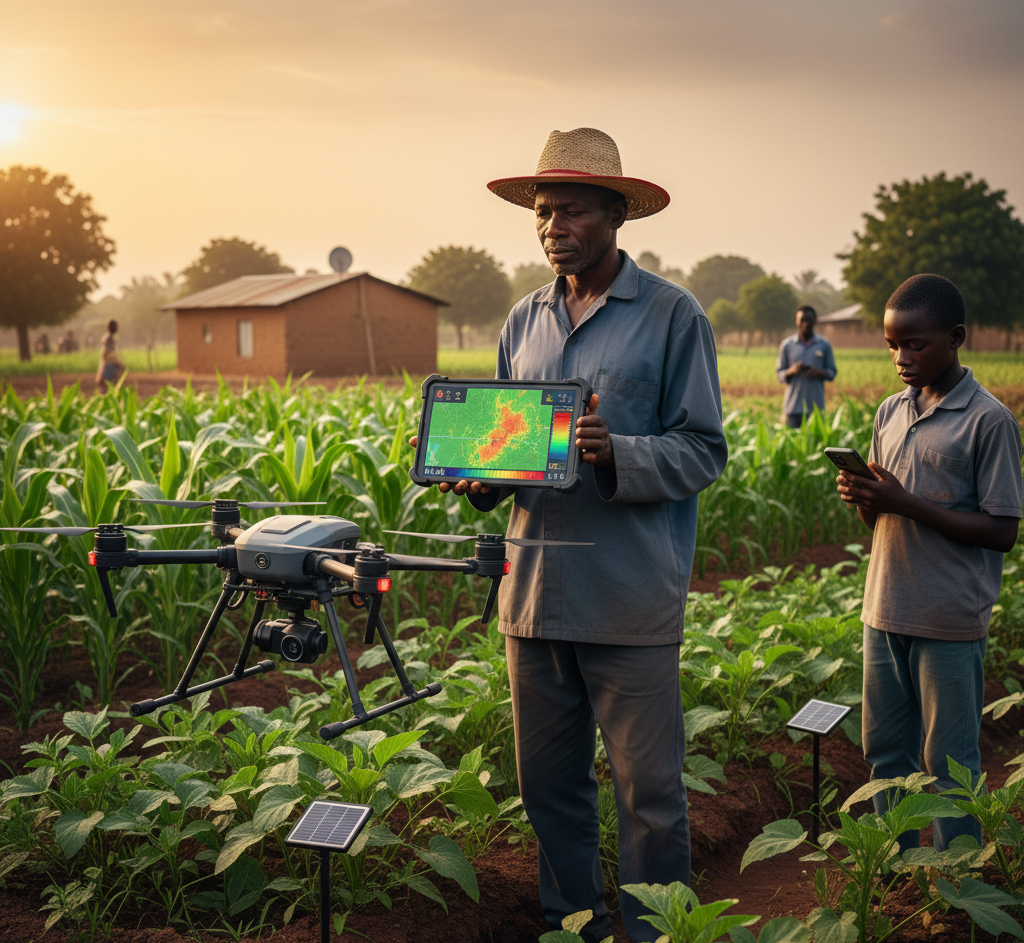
Nigerian agritech companies are deploying AI systems that monitor soil health, predict weather patterns, and optimize irrigation in real-time. Companies like ColdHubs use AI to optimize solar-powered cold storage, reducing post-harvest losses by 80%. Meanwhile, Farmcrowdy integrates AI to match farmers with investors and provide personalized recommendations.
Why It’s Game-Changing
According to the FAO’s 2024 Africa report, farms using precision agriculture increase yields by 30-40% while reducing water usage by 25%. For Nigeria, where agriculture employs 36% of the workforce, these improvements are transformative.
Small-scale farmers using AI-powered recommendations report income increases of 50-70% within the first year. Furthermore, reduced post-harvest losses mean more food reaches markets at lower prices.
How You Can Get Involved
Skills in demand include computer vision for crop analysis, IoT sensor integration, mobile app development, and data analytics. Our guide on how to use AI tools to earn money in Africa includes agritech opportunities.
2. Blockchain Certificate Verification: Ending Fraud
Blockchain certificate verification uses distributed ledger technology to create tamper-proof academic credentials. When universities award degrees, the information gets encrypted and stored across blockchain networks. Consequently, employers can verify certificates in seconds.
Universities, including the University of Lagos, Covenant University, and Ahmadu Bello University, have begun pilot programs. Additionally, the NUC is exploring a nationwide system.
Why It’s Game-Changing
Certificate fraud costs Nigeria ₦20 billion annually. Traditional verification takes weeks; blockchain verification happens in 30 seconds at near-zero cost. Therefore, hiring processes accelerate while eliminating fraud entirely.
This particularly benefits Nigerian professionals working abroad. International employers can instantly verify Nigerian degrees without complex authentication processes. According to MIT Technology Review, Nigeria ranks among the top five countries globally in blockchain adoption for public services.
How You Can Get Involved
Career opportunities include blockchain development, smart contract engineering, and university implementation consulting. Our article on Nigeria’s AI blockchain ending certificate fraud provides deeper insights.

3. Fintech Super Apps: Beyond Payments
Fintech super apps like OPay, Moniepoint, and PalmPay have evolved from payment platforms to comprehensive financial ecosystems. In a single app, users can receive salary, pay bills, apply for loans, invest, purchase insurance, and order food.
Why It’s Game-Changing
Financial inclusion in Nigeria jumped from 38% in 2019 to over 64% in 2024. According to Techpoint Africa’s 2025 report, fintech lending has enabled over 2 million Nigerians to start or expand businesses. Moreover, these apps process over ₦15 trillion monthly.
Unlike traditional banks, super apps use AI and alternative data to assess creditworthiness, serving demographics banks ignored: small business owners, gig workers, and young professionals.
How You Can Get Involved
Skills in demand include payment gateway integration, financial API development, mobile UX/UI design, and fraud detection. Our guide to the best AI tools for small businesses in Nigeria shows how to leverage fintech tools.
Image: Nigerian fintech super apps offering comprehensive financial services
4. Edge AI & Local Language Processing
Google, Microsoft, and local startups are building AI that understands Yoruba, Igbo, Hausa, and other Nigerian languages. Furthermore, edge AI means these capabilities run on local devices without constant cloud connectivity.
Recent breakthroughs include Google’s PaLM 2 supporting Yoruba, Microsoft’s Azure adding Igbo and Hausa, and local startups building voice assistants for Nigerian pidgin.
Why It’s Game-Changing
Language has been technology’s great barrier. Despite 50%+ smartphone penetration, many Nigerians struggle with English-only interfaces. Local language AI changes this fundamentally.
Market traders in Kano can now use voice assistants in Hausa. Farmers in Enugu access agricultural information in Igbo. According to UNESCO, this technology also helps preserve endangered African languages.
How You Can Get Involved
Developers who understand both technology and local languages are in extremely high demand. Our guide on Google Voice Search for African languages explores how to leverage this technology.
Career opportunities include NLP engineering, voice interface design, and dataset creation.
Image: AI voice assistant processing Nigerian local languages
5. Local Cloud Infrastructure & Data Sovereignty
Microsoft’s $1 billion+ investment includes constructing hyperscale data centers in Lagos. Similarly, Google has expanded its cloud presence. Consequently, Nigerian businesses access world-class cloud services with dramatically reduced latency.
Why It’s Game-Changing
For years, African developers struggled with 300-500ms latency. Local data centers reduce this to under 50ms, making Nigerian apps as responsive as those built in Silicon Valley. Moreover, costs drop 40-60% due to reduced international bandwidth.
Data sovereignty means data stays within Nigerian borders, subject to Nigerian law. Therefore, government agencies and banks can use cloud services without compromising security.
According to our analysis of AI careers and salaries in Africa, cloud infrastructure roles pay among Nigeria’s highest tech salaries.
Our analysis of Microsoft’s AI investment in Nigeria explores both opportunities and critical gaps in this infrastructure push.
How You Can Get Involved
Skills in demand include cloud architecture, DevOps, cybersecurity, and cloud-native development. Learning to build AI automation agencies becomes more viable with local infrastructure.
What This Means for You
For Developers
These tech innovations Nigeria is experiencing create unprecedented demand. High-growth areas include AI/ML engineering, blockchain development, cloud architecture, and mobile development.
Start by mastering fundamentals, then specialize. Our analysis of AI job trends in Africa shows which skills command the highest salaries.
For Entrepreneurs
Each innovation represents massive opportunities. The most successful startups combine multiple innovations, agritech platforms using local language AI, fintech APIs, and cloud infrastructure.
Explore the best AI tools for small businesses to operate efficiently while building your startup.
For Students
Focus on skills aligned with these technologies. Understanding which AI jobs pay the most helps with career planning.
Nigeria’s emerging hubs, like Jos, Plateau State, offer opportunities beyond Lagos.
Conclusion
The tech innovations Nigeria is experiencing in 2026 represent transformative shifts. From AI agriculture to blockchain verification, from fintech super apps to local language AI, to cloud infrastructure, each unlocks massive potential.
Moreover, these create unprecedented opportunities for those willing to position themselves at the forefront. The infrastructure is being built. The training is available. The opportunities are real.
Which innovation excites you most? Share your thoughts below.
Take Action
- Subscribe for ongoing analysis of tech innovations transforming Nigeria
- Explore our AI in Africa pillar page for comprehensive coverage
- Check our AI tools guide for practical tools
- Join the conversation: Which innovation will have the biggest impact?