By Samuel Dabit | Creative Tech Africa
Introduction: A Continent in Motion, But Not Evenly So
Africa’s AI story is being told with growing confidence. Startup funding for AI-focused ventures on the continent crossed $650 million in 2024, according to Partech Africa. More than 450 AI-oriented companies now operate across African markets, from Nairobi to Cairo to Lagos. International technology giants are making visible bets: cloud infrastructure, developer programmes, language model localisation projects, and regional AI policy frameworks are all accelerating.
But here is the part that rarely makes the headline: this momentum is concentrated. Nigeria, Kenya, South Africa, Egypt, and Rwanda account for the overwhelming majority of reported activity. Within those countries, capital and talent funnel further into a handful of urban centres, Lagos above all. The result is a landscape that is simultaneously exciting and uneven, one where pockets of genuine innovation coexist with vast regions that the global AI conversation has largely passed over.
That unevenness is not just a development challenge. It is also a missed opportunity. Because outside the well-mapped corridors of Victoria Island and Yaba, communities of builders, researchers, and founders are quietly laying foundations. The question worth asking, and worth answering with evidence, is how those communities connect with the formal institutions, research bodies, and policy frameworks that give emerging ecosystems staying power.
The Current Landscape of AI in Africa
Africa’s AI ecosystem has real structural advantages: a young, digitally engaged population, a strong tradition of improvising around infrastructure constraints, and a set of deeply local problems in agriculture, healthcare, financial access, and logistics that are themselves powerful incentives for applied AI development.
The structural gaps, however, are significant. Compute infrastructure remains expensive and unevenly distributed. Reliable electricity and high-speed internet, prerequisites for serious AI work, are still not givens in much of the continent. AI research output, measured in peer-reviewed publications, open datasets, and model development, remains thin relative to the continent’s population. Most critically, the investment in formal AI education and research institutions has not kept pace with the speed of startup activity on the ground.
The result is a gap between enthusiasm and depth. Many people are learning to use AI tools; there are far fewer producing original research, building foundational models, or generating the kind of knowledge infrastructure that sustained tech ecosystems depend on. Analysts who track African tech investment consistently find that the top three or four cities on the continent absorb the majority of disclosed funding, a concentration that shapes not just capital flows but also which communities get to define the ecosystem’s direction. Nigeria, as Africa’s largest economy and most populous country, reflects this tension sharply. Lagos is loud with activity. But the north, home to roughly half the country’s population, has been conspicuously absent from most accounts of Nigeria’s AI ecosystem.
That is beginning to change.
The Role of AI Research Institutions
Ecosystems do not survive on enthusiasm alone. They need knowledge infrastructure: institutions that conduct original research, translate findings into practice, train the next generation of practitioners, and advise policymakers on evidence-based frameworks. In more mature tech geographies, such as Singapore, Tel Aviv, and Bangalore, the presence of strong research institutions created a long-term foundation that outlasted individual startup cycles.
Africa’s research institution landscape in AI is still developing, but it is developing with intention. Organisations focused explicitly on AI research in African contexts are beginning to occupy a distinct and important role: not just producing papers, but building bridges between academic knowledge and on-the-ground implementation. The Africa Research Institute for AI (ARIFA) represents this orientation in a particularly relevant way. Rather than operating purely in academic space, ARIFA works at the intersection of research, policy, and real-world ecosystems, generating knowledge that is grounded in African contexts, and then working to ensure that knowledge reaches the people who can act on it: policymakers crafting national AI strategies, regional hubs training the next generation of practitioners, and community innovators who need frameworks, not just tools. In an ecosystem where the distance between formal research and lived practice is wide, that positioning matters.
What makes research institutions particularly valuable at this stage of Africa’s AI development is not just what they know, but what they connect. A research body embedded in the continent’s realities can link community innovators with funding pathways, connect regional hubs with international academic networks, inform government policy with practical evidence, and help frame the continent’s AI development in terms that are both technically credible and contextually grounded. That connective function, between knowledge and action, between global frameworks and local practice, is where institutions like these can have their most significant impact.
The risk, of course, is the opposite: that research stays siloed, that academic knowledge fails to reach the builders working in cities like Jos, Kano, or Kaduna, and that the gap between formal institutions and grassroots communities widens rather than narrows. Closing that gap is one of the defining challenges for Africa’s AI ecosystem in the coming decade.
Case Study: Northern Nigeria’s Emerging AI Ecosystem
Jos, the capital of Plateau State, sits roughly 1,200 metres above sea level on the Nigerian middle belt. It is not a city that features prominently in global tech narratives. But in November and December of 2025, it hosted two events that together painted a compelling picture of what an emerging regional AI ecosystem actually looks like, not in theory, but in practice.
HackJos 2025, held at Fox Hotel from November 10–12, marked the 10th anniversary of nHub, Northern Nigeria’s pioneering innovation hub. Over three days, more than 500 innovators, entrepreneurs, policymakers, and developers gathered around a single theme: driving growth for micro, small, and medium enterprises through technology. The event produced over 100 prototypes across four challenge tracks: e-commerce, financial inclusion, productivity tools, and logistics.
The winning projects were not vanity showcases. AGRIVAULT, which took first place, developed an AI-blockchain platform designed to give farmers access to instant loans using inventory as collateral, a direct response to the chronic exclusion of rural agricultural communities from formal credit. HARAJI, the runner-up, built a rural marketplace app focused on last-mile delivery, aiming to reduce delivery times for off-grid businesses. LALITA, third place, created an AI-powered scheduling tool for small operators, automating payroll and time management for founders who cannot afford dedicated HR software.
These projects matter not because of their polish, many were early-stage prototypes, but because of their problem orientation. They are built by people who understand, from lived experience, the friction points in Nigeria’s informal economy. That kind of contextual knowledge is not something that can be imported.
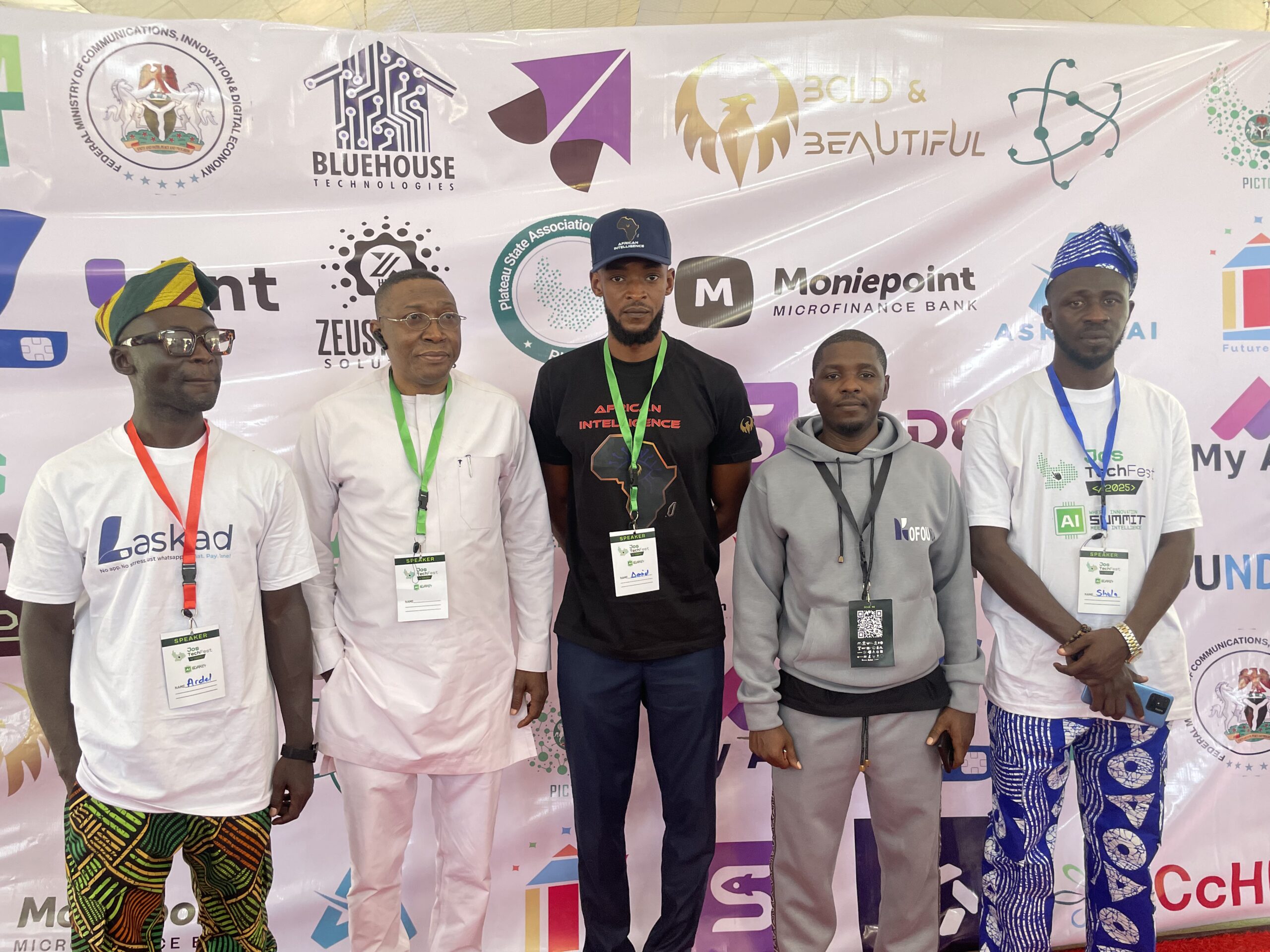
Less than a month later, on December 4, Jos hosted Jos Tech Fest 2025 at Sarau Event Center, under the theme “Where Innovation Meets Intelligence.” The event brought together developers, creatives, students, and founders for a day of keynotes, panels, product showcases, and networking. The sessions ranged from AI in education, featuring platforms like African Intelligence, which is developing AI-powered learning tools for the continent, to AI for business productivity, developer automation, and creative applications. A fireside conversation explored how AI tools can preserve and amplify African cultural narratives rather than displace them.
What stood out across both events was the breadth of the conversation. These were not events about AI in the abstract. They were conversations about specific problems, how to get a farmer in rural Plateau State a loan, how to help a small trader in Jos manage her inventory, how to give a developer in Kaduna tools that compress weeks of work into days. The AI ecosystem in Northern Nigeria is still young, but it is thinking about the right things.
Northern Nigeria’s developer engagement reportedly grew by around 40 percent in 2025, according to data from the Google Africa Developer Report. That number aligns with what events like HackJos and Jos Tech Fest suggest on the ground: a community that is growing in both size and sophistication, supported by a decade of sustained institution-building by organisations like nHub.
Bridging Research and Reality
The gap between formal AI research and on-the-ground implementation is a well-documented challenge in most of the world. In Africa, it carries particular stakes. Research that is conducted without community input risks producing solutions that do not address actual problems. Communities building without research infrastructure risk reinventing wheels, missing safety considerations, or failing to generate the kind of replicable knowledge that turns individual experiments into shared progress.
Events like HackJos and Jos Tech Fest are doing something more than they might appear to be doing on the surface. Yes, they produce prototypes and create networking opportunities. But they are also functioning as knowledge-transfer mechanisms. When a policy advisor from GIZ-SEDIN addresses a room of young developers about the barriers facing MSMEs, she is translating institutional knowledge into the language of builders. When a founder shares the honest story of iterating a product under resource constraints, she is making tacit knowledge explicit for others who will face the same constraints. These exchanges are informal, but they are real.
What these communities still need, and what formal research institutions are positioned to provide, is the layer above: published frameworks, structured data, policy toolkits, and research collaborations that give the lessons learned in a Jos hackathon legibility and weight in broader conversations. The challenge for institutions is to develop genuine partnerships with regional communities, rather than studying them from a distance.
This is a two-way relationship. Research bodies need the empirical grounding that comes from communities doing real implementation work. Communities need the credibility, technical depth, and policy influence that institutions can provide. Neither is sufficient alone.
Challenges and Opportunities
The challenges facing AI development in Northern Nigeria, and, by extension, across much of Africa’s underrepresented regions, are neither mysterious nor insurmountable. They are structural, and they are knowable.
Infrastructure remains the most basic constraint. Inconsistent electricity supply and limited access to affordable, high-speed internet create real friction for AI work at every level, from training models to running cloud-based tools. Any honest account of the ecosystem has to acknowledge that ambitious AI development is significantly harder in a city with a four-hour daily power supply than in one with 24-hour grid stability.
Funding is the second structural gap. Venture capital in Nigeria flows heavily toward Lagos, and within Lagos, toward sectors and founders with existing relationships in the funding community. Developers and founders in Jos, Kano, or Maiduguri face a steeper climb to access the same opportunities, regardless of the quality of their ideas. Grant funding from development organisations, GIZ, DAI, and others, has filled some of that gap, as the sponsorship list for HackJos 2025 illustrates, but grant cycles and innovation timelines do not always align.
Talent retention is a related concern. Northern Nigeria produces skilled developers and technologists, many of them trained through programmes at nHub and similar organisations. The pull of Lagos, Abuja, or international opportunities is real. Building ecosystems that give talented people compelling reasons to stay and build locally is a long-term project that requires more than events; it requires viable commercial opportunities.
Awareness and representation are also genuine issues. When AI in Nigeria is discussed, the default frame is Lagos. That default shapes where resources flow, who gets invited to speak at conferences, and which communities get written into the broader story. Changing that frame requires deliberate, sustained documentation of what is happening outside the default, exactly the kind of work that platforms like Creative Tech Africa and organisations like Africa Research Institute for AI are positioned to contribute.
The opportunities are equally real. The problems that Northern Nigerian communities are trying to solve, such as agricultural finance, last-mile logistics, MSME productivity, and accessible education, are large, underserved, and commercially viable. Solutions developed here, with genuine local context, have potential reach not just in Nigeria but across comparable markets throughout the continent and the global south.
The Road Ahead
Africa’s AI ecosystem will not achieve its potential through Lagos alone. The depth and resilience of any continental ecosystem depend on the breadth of its participants, the diversity of problems being worked on, the range of contexts informing solutions, and the geographic spread of communities with the skills and resources to build.
For that to happen, several things need to be true simultaneously.
Research institutions need to move toward the communities, not wait for communities to arrive at institutions. That means fieldwork, partnerships with regional hubs, and research agendas that are shaped by on-the-ground practitioners rather than defined purely by academic conventions.
Community organisations need to invest in documentation and knowledge transfer. The intellectual value produced at events like HackJos is significant, but it dissipates quickly if not captured. Structured mechanisms for publishing findings, tracking what works, and sharing learnings across the ecosystem would substantially increase the long-term impact of grassroots innovation.
Funding mechanisms need to reach beyond Lagos. Development organisations already present in Northern Nigeria, GIZ-SEDIN’s support of HackJos is a clear example, understand this. The challenge is ensuring that funding flows are consistent enough to sustain multi-year ecosystem building, not just episodic event support.
And the media ecosystem, including technology publications, needs to expand its frame of reference. The story of AI in Africa is not adequately told if it only includes the coastal cities and capital markets. The fuller, more accurate story includes Jos, Kano, Kaduna, Enugu, Abeokuta, Kumasi, and dozens of other cities where serious people are doing serious work with limited resources and deep local knowledge.
Conclusion: The Foundation is Being Laid
Africa’s AI future will not be determined by any single conference, any single institution, or any single city. It will be determined by whether the continent can build the connective tissue between formal knowledge systems and grassroots implementation, and whether that connection reaches the regions that need it most.
What happened in Jos in late 2025, more than 500 innovators at HackJos building tools for farmers and small traders, hundreds more at Jos Tech Fest exploring what it means to build AI-native products in a Northern Nigerian context, is not a footnote to Africa’s AI story. It is part of the main text.
The gap between research and reality in African AI is real, but it is not fixed. What closes it is not a single intervention; it is the sustained, deliberate work of institutions willing to move toward communities, communities willing to document what they learn, and platforms willing to tell the story accurately. Africa does not need a single AI capital. It needs a connected ecosystem. The signals coming out of Jos suggest that connection is already being built, one event, one prototype, one partnership at a time. The continent’s AI future will belong to whoever shows up consistently, not just in the places already on the map.
About the Author
Samuel Dabit is a Nigerian technology writer and SEO specialist covering artificial intelligence, emerging African tech ecosystems, and digital transformation. He writes for Creative Tech Africa, where he analyses AI innovation and developer communities across the continent. His work focuses on under-reported regional ecosystems and the grassroots developer culture shaping Africa’s technology future.