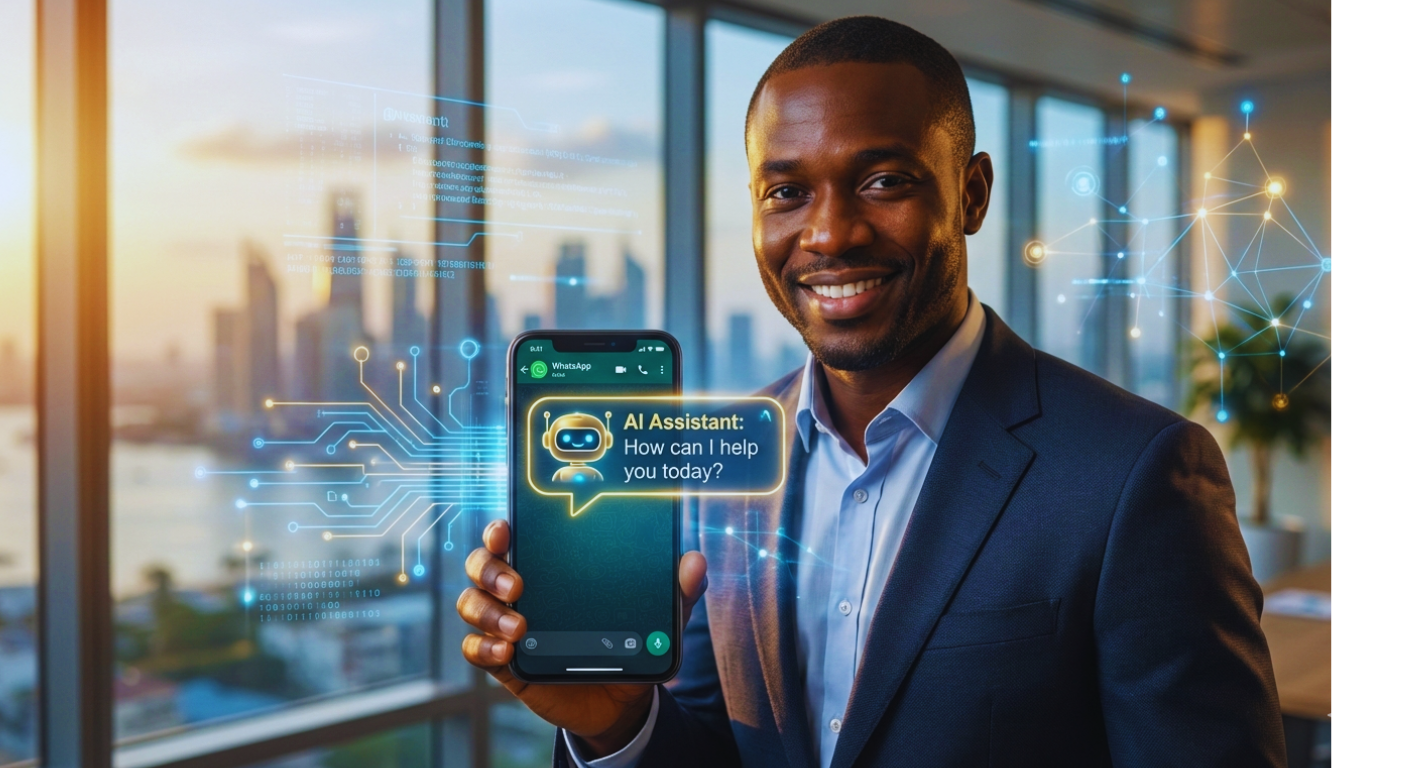
In Lagos, a fashion startup reduced customer service costs by 70% in just two months. Meanwhile, an Abuja-based fintech saved ₦300,000 monthly on content creation. Across the country, AI WhatsApp Business Nigeria is proving to be a game-changer, as businesses use AI-powered WhatsApp to transform customer engagement, not on some fancy new platform, but right where customers already spend hours every day. By combining WhatsApp automation with artificial intelligence, Nigerian companies are cutting costs, scaling support, and competing globally without breaking the bank.
With 95% of Nigeria’s digital population using WhatsApp and AI chatbot adoption surging across African markets, Nigerian businesses now have unprecedented opportunities. Specifically, AI WhatsApp business solutions enable companies to automate operations, scale customer service, and compete globally, all without massive infrastructure investments.
Consequently, this comprehensive guide explores how to leverage WhatsApp AI in Nigeria to transform your business in 2026, backed by real statistics, proven strategies, and actionable implementation steps.
Why AI WhatsApp Business Nigeria Is the Perfect Tech Storm
The Numbers Tell the Story
Nigeria’s WhatsApp adoption isn’t just high, it’s nearly universal. According to recent global WhatsApp statistics, over 95% of Nigeria’s digital population uses WhatsApp daily, making it the country’s de facto communication platform. Furthermore, WhatsApp Business has seen explosive growth, with over 200 million small and medium enterprises globally now using the platform.
Simultaneously, the AI revolution is happening at unprecedented speed. Nigeria hosts over 400 AI-focused companies, and by mid-2025, approximately 9.3% of Nigeria’s working-age population had adopted AI tools, a number growing rapidly as financial services, retail, and tech startups lead the charge.
When you combine WhatsApp’s reach with AI’s capabilities, therefore, you get a powerful formula:
- 98% message open rate (compared to 20% for email)
- 80% open rate within the first 5 minutes of sending
- 30% cost reduction on customer support
- 2.5 billion working hours saved globally through chatbot automation
For context, this technological convergence is part of Africa’s broader AI adoption trend, where countries are leveraging mobile-first solutions to leapfrog traditional infrastructure challenges.
Why Nigerian Businesses Are Moving to WhatsApp
Traditional customer service channels present unique challenges in Nigeria:
- High cost: Call centers require significant infrastructure
- Limited hours: Most businesses can’t afford 24/7 human support
- Power interruptions: Unreliable electricity makes consistent service difficult
- Data costs: Website browsing consumes more data than WhatsApp messages
- Trust gap: Customers hesitate to share information on unfamiliar platforms
Fortunately, WhatsApp solves all of these problems. It’s already on every Nigerian’s phone, it works on low data, it feels familiar and trusted, and when powered by AI, it can provide instant 24/7 support at a fraction of traditional costs.
According to industry research, 67% of consumers prefer messaging over phone or email for support, and 54% of users prefer receiving marketing messages via WhatsApp. Moreover, in Nigeria, where mobile is king, these preferences are even stronger.
How AI WhatsApp Business Nigeria Is Transforming Nigerian Businesses
Real Success Stories: WhatsApp AI Nigeria in Action
Fashion Retail – Lagos A Lagos-based fashion startup integrated Chatbase to handle WhatsApp orders. Remarkably, within 2 months, they achieved:
- Reduced manual replies by 70%
- Freed up two full-time employees for sales-focused work
- Increased order processing speed by 3x
- Maintained 24/7 customer availability
Fintech – Abuja. Similarly, an Abuja fintech deployed AI-powered content generation for WhatsApp marketing:
- Generated daily social media posts and newsletters using ChatGPT
- Tripled engagement rates through consistent, personalized messaging
- Saved ₦300,000 monthly in outsourced writing costs
- Maintained brand voice through AI training and human editing
E-commerce – Nationwide. Additionally, Nigerian e-commerce businesses using WhatsApp chatbots report:
- 20-30% reduction in cart abandonment
- 7-25% revenue boost from abandoned cart recovery
- 30% improvement in order tracking efficiency
- 24/7 customer support without additional staffing
These results align with broader trends in how Nigerian startups are using AI tools to boost productivity and compete globally.
Key WhatsApp AI Applications for Nigerian Businesses
1. Customer Service Automation with AI First and foremost, AI-powered WhatsApp chatbots can handle:
- Frequently asked questions
- Order status inquiries
- Product recommendations
- Appointment scheduling
- Basic troubleshooting
Notably, Nigerian banks and fintech companies are leading this charge. In fact, 60% of financial institutions now use WhatsApp AI for customer service and transaction notifications.
2. AI-Driven Sales and Lead Qualification. In addition to customer service, WhatsApp AI business systems can:
- Qualify leads through conversational questions
- Provide product information instantly
- Guide customers through the purchase process
- Offer personalized recommendations
- Send timely follow-ups
As a result, businesses report 27% increases in sales conversion rates when using AI WhatsApp for lead nurturing.
3. Marketing and Customer Engagement via WhatsApp AI. Furthermore, AI-powered marketing on WhatsApp enables:
- Personalized broadcast messages
- Automated drip campaigns
- Flash sales notifications
- Customer segmentation
- Behavioral targeting
Indeed, 45% of online businesses report increased sales directly from WhatsApp AI marketing campaigns.
4. Operational Efficiency Beyond customer-facing applications, AI on WhatsApp helps with:
- Team coordination and task management
- Internal notifications and updates
- Document sharing and collaboration
- Performance tracking and reporting
Regulatory Landscape: Navigating Nigeria’s AI and Data Policies
While the opportunities are immense, Nigerian businesses must navigate evolving regulatory frameworks. Understanding these regulations isn’t just about compliance; it’s about building customer trust and avoiding costly penalties.
Nigeria Data Protection Regulation (NDPR)
The NDPR guidelines require businesses to:
- Obtain explicit consent before collecting customer data
- Clearly communicate how data will be used
- Implement adequate security measures
- Provide customers with data access and deletion rights
- Report data breaches within 72 hours
For WhatsApp AI implementation, this means:
- Include clear opt-in mechanisms for chatbot interactions
- Store chat histories securely and encrypt sensitive information
- Allow customers to request their conversation data
- Implement data retention policies
- Train AI models without exposing personal customer information
Emerging AI Governance
Currently, Nigeria is developing comprehensive AI policies through the National Centre for Artificial Intelligence and Robotics (NCAIR). Although regulations are still evolving, businesses should prepare for:
- Algorithm transparency requirements
- Bias testing and fairness assessments
- Human oversight mechanisms
- Clear disclosure when customers interact with AI
As detailed in our AI governance and regulation coverage, proactive compliance positions businesses as trustworthy and future-ready.
WhatsApp Business API Compliance
Similarly, Meta’s WhatsApp Business API has its own requirements:
- Business verification process
- Message template approval (24-hour response window for non-template messages)
- Opt-in requirements for marketing messages
- Spam and quality rating monitoring
- Content policy compliance
Best Practice: Work with Meta-verified Business Solution Providers (BSPs) who understand both WhatsApp’s policies and Nigerian market requirements.
Implementation Guide: Building Your WhatsApp AI Nigeria Strategy
Step 1: Choose the Right Tools for Your Business Size
For Small Businesses (1-10 employees)
- WhatsApp Business App (Free)
- Built-in automation with quick replies
- Away messages and greeting messages
- Business profile and catalog
- Suitable for businesses receiving <100 messages daily
- Recommended AI Integration: ChatGPT or Claude for drafting responses
- Copy customer questions into the AI tool
- Generate professional responses
- Review and personalize before sending
- Build a knowledge base of common answers
For Medium Businesses (10-50 employees)
- Third-party Chatbot Platforms
- Chatbase (easiest to train with existing content)
- CDIAL.AI (African-focused, handles Nigerian English and Pidgin)
- Landbot or ManyChat (user-friendly, template-based)
- Cost: ₦10,000-₦30,000 monthly
- Key Features to Look For:
- No-code setup (drag-and-drop interface)
- CRM integration (for customer data)
- Analytics dashboard
- Multi-agent support
- Mobile accessibility
For Large Businesses (50+ employees)
- WhatsApp Business API
- Official enterprise solution
- Unlimited messaging (with per-message fees)
- Multiple user access
- Advanced automation and integrations
- Cost: Starting at $0.0085 per 250,000 messages
- Recommended Platforms:
- Infobip (strong Nigerian presence)
- Twilio
- MessageBird
- 360dialog
Importantly, for businesses at any scale, exploring the best AI tools for Africans in 2025 can provide additional context on mobile-friendly, budget-conscious options.
Step 2: Train Your AI Chatbot for WhatsApp
Preparation Phase (Week 1-2)
- Collect your last 100-200 customer questions
- Review email inquiries
- WhatsApp conversation history
- Social media DMs
- Call center logs
- Identify patterns and create categories
- Product information requests
- Pricing and payment questions
- Order status inquiries
- Technical support issues
- Complaints and returns
- Write clear, comprehensive answers
- Use conversational Nigerian English
- Include relevant links and resources
- Add appropriate emojis (sparingly)
- Keep responses under 250 characters when possible
Training Phase (Week 2-3)
- Feed your Q&A database to the AI
- Most platforms allow CSV upload or manual entry
- Organize by topic/category
- Include variations of common questions
- Test extensively before launch
- Try different phrasings of questions
- Test in Nigerian English, formal English, and common Pidgin phrases
- Check for appropriate tone
- Verify the accuracy of information
- Set up fallback responses
- “I’m not sure about that. Let me connect you with [Name] from our team.”
- Include estimated human response time
- Collect the questions for training improvement
Optimization Phase (Ongoing) Subsequently, you’ll need to:
- Review unanswered questions weekly
- Update responses based on new products/policies
- Track customer satisfaction ratings
- Refine based on conversation analytics
Meanwhile, continually improve your WhatsApp AI performance by analyzing which questions get the best responses and which need human intervention.
Step 3: Integrate with Your Business Systems
Essential Integrations
- CRM System
- Sync customer contact information
- Track conversation history
- Segment customers for targeted campaigns
- Popular Nigerian-friendly options: HubSpot, Zoho, Salesforce
- Payment Gateway
- Allow in-chat payments
- Send payment links
- Confirm transactions automatically
- Options: Paystack, Flutterwave, Interswitch
- Inventory Management
- Real-time stock availability
- Automatic order processing
- Delivery tracking updates
- Analytics Platform
- Monitor response times
- Track conversion rates
- Measure customer satisfaction
- Identify bottlenecks
Step 4: Launch Strategy
Soft Launch (Week 1). Initially, you should:
- Enable chatbot for 20% of customers
- Monitor conversations closely
- Fix issues quickly
- Gather feedback
Gradual Rollout (Week 2-4) Then, progressively:
- Increase to 50%, then 75%, then 100%
- Train staff to handle escalations
- Refine automation rules
- Build confidence
Promotion. Finally, once fully operational:
- Update all marketing materials with the WhatsApp number
- Add click-to-WhatsApp buttons on the website
- Include in email signatures
- Promote on social media
- Incentivize first WhatsApp contact (small discount/freebie)
Real-World Use Cases Across Industries
1. Retail and E-commerce
Primary Applications:
- Product catalog browsing through WhatsApp catalogs
- Personalized recommendations based on browsing history
- Automated order confirmations and tracking
- Abandoned cart recovery with gentle nudges
- Customer reviews and feedback collection
AI Enhancement: Moreover, advanced features include:
- Visual product search using image recognition
- Size and style recommendations
- Inventory alerts for out-of-stock items
- Dynamic pricing updates
- Predictive restocking notifications
Projected Impact: E-commerce businesses are expected to see 80% chatbot adoption by 2026. Additionally, those using WhatsApp AI Nigeria report 20-30% reductions in cart abandonment.
2. Healthcare and Telemedicine
Primary Applications:
- Appointment scheduling and reminders
- Symptom checkers (triage)
- Test results delivery
- Prescription refill requests
- Health tips and educational content
AI Enhancement: Furthermore, healthcare AI can provide:
- Preliminary diagnosis assistance
- Medication interaction warnings
- Follow-up care reminders
- Mental health support chatbots
- Multilingual support for diverse patients
Nigerian Context: Following Rwanda’s success with Babyl telemedicine (serving 62% of adults with 91% satisfaction), Nigerian healthtech startups are deploying similar AI-powered WhatsApp solutions.
3. Financial Services
Primary Applications:
- Account balance inquiries
- Transaction notifications
- Fraud alerts
- Loan application assistance
- Financial literacy content
AI Enhancement: Furthermore, fintech platforms can offer:
- Personalized savings recommendations
- Spending pattern analysis
- Investment advice
- Credit score monitoring
- Budget tracking assistance
Market Reality: Impressively, 60% of financial institutions globally now use WhatsApp AI for customer service. In particular, Nigerian banks and fintechs are leading African adoption.
4. Education and EdTech
Primary Applications:
- Class schedules and reminders
- Assignment submissions
- Grade notifications
- Study material distribution
- Parent-teacher communication
AI Enhancement: In addition, educational AI enables:
- Personalized learning recommendations
- Automated essay grading
- Study buddy chatbots
- Quiz and test generation
- Progress tracking and insights
Understanding these AI use cases in education and across sectors helps businesses identify opportunities. Moreover, it demonstrates how WhatsApp AI Nigeria solutions can be adapted to industry-specific needs.
5. Logistics and Delivery
Primary Applications:
- Real-time delivery tracking
- Driver-customer communication
- Address verification
- Delivery confirmation
- Feedback collection
AI Enhancement: Similarly, logistics AI can handle:
- Route optimization suggestions
- ETA predictions
- Automated rescheduling
- Package location updates
- Delivery issue resolution
Cost-Benefit Analysis: What to Expect
Initial Investment
Small Business Setup (Monthly)
- WhatsApp Business App: Free
- AI assistant subscription (ChatGPT Plus): ₦12,000-₦15,000
- Training time investment: 10-15 hours
- Total Monthly Cost: ₦12,000-₦15,000
Medium Business Setup (Monthly)
- Chatbot platform: ₦10,000-₦30,000
- WhatsApp Business API (if needed): ₦20,000-₦50,000
- Integration and training: ₦50,000-₦100,000 (one-time)
- Total Monthly Cost: ₦30,000-₦80,000
Large Enterprise Setup (Monthly)
- WhatsApp Business API: ₦100,000-₦500,000
- AI platform license: ₦200,000-₦1,000,000
- Custom development: ₦2,000,000-₦5,000,000 (one-time)
- Total Monthly Cost: ₦300,000-₦1,500,000
Expected Returns
Based on industry data and Nigerian success stories, businesses can anticipate:
Cost Savings Significantly, you can expect:
- 30% reduction in customer support costs
- 70% fewer manual customer service tasks
- 2.5 billion hours saved globally (scalable to business size)
- Elimination of expensive call center infrastructure
Revenue Growth. Moreover, revenue improvements include:
- 20-30% reduction in cart abandonment
- 7-25% revenue increase from recovery campaigns
- 45% of businesses report increased sales
- 27% higher conversion rates for lead nurturing
Efficiency Gains. In addition, operational benefits include:
- 35% faster response times
- 80% open rate within 5 minutes
- 98% message open rate overall
- 24/7 availability without additional staffing
ROI Timeline Consequently, break-even timelines vary:
- Small businesses: Break-even in 1-2 months
- Medium businesses: Break-even in 3-6 months
- Large enterprises: Break-even in 6-12 months
Common Challenges and Solutions
Challenge 1: Poor AI Understanding of Nigerian English and Pidgin
Problem: Generic AI models struggle with local language nuances, leading to confused customers and incorrect responses.
Solution: Therefore, businesses should:
- Use platforms with Nigerian English training (like CDIAL.AI)
- Build a glossary of common local terms and their formal equivalents
- Test extensively with Nigerian team members
- Include context examples in your training data
- Set up a fallback for unrecognized phrases
Example:
Customer: "Abeg, wetin be the price for that shoe?"
AI (Trained): "The shoe costs ₦15,000. Would you like to place an order?"
AI (Untrained): "I don't understand your question."
Challenge 2: Customer Trust in AI Conversations
Problem: Nigerians may be skeptical of automated systems, especially for sensitive transactions.
Solution: To build trust, you should:
- Be transparent about AI usage
- Offer easy escalation to humans
- Use a conversational, friendly tone
- Include trust signals (verified business badge, testimonials)
- Provide human oversight for complex issues
Best Practice: “Hi! I’m the TechHub assistant. I can help you with product info, order tracking, and FAQs. For complex issues, I’ll connect you with our team. How can I help today?”
Challenge 3: Network Connectivity and Data Limitations
Problem: Inconsistent internet access and data costs affect message delivery and customer experience.
Solution: Consequently, optimize for low bandwidth:
- Keep messages concise (under 250 characters)
- Use text-based responses over images/videos when possible
- Implement message queuing for failed deliveries
- Offer alternative contact methods
- Optimize chatbot responses for low-bandwidth scenarios
Challenge 4: Maintaining Quality During Scale
Problem: As message volume grows, maintaining response quality becomes challenging.
Solution: Therefore, implement quality controls:
- Implement tiered support (AI → human agent → specialist)
- Set clear AI capability boundaries
- Regular quality audits of AI responses
- Continuous training with new questions
- Monitor customer satisfaction metrics
Quality Metrics to Track:
- Average response time
- Resolution rate (percentage solved by AI)
- Customer satisfaction score
- Escalation rate to humans
- First-contact resolution
Challenge 5: Privacy and Data Security
Problem: Handling sensitive customer information requires strict security measures.
Solution: As a result, implement robust security:
- End-to-end encryption (built into WhatsApp)
- Secure data storage with encrypted databases
- Regular security audits
- NDPR compliance protocols
- Clear data retention policies
- Staff training on data protection
Future Trends: What’s Next for AI and WhatsApp in Nigeria
1. Multimodal AI Capabilities (2026-2027)
What’s Coming:
- Voice message transcription and response
- Image recognition for product search
- Video consultation integration
- Document scanning and processing
Business Impact: Customers can send photos of products they want, voice messages in local languages, or documents for processing—all handled by AI.
Market Projection: 40% of generative AI solutions will be multimodal by 2027, according to Gartner.
2. Hyper-Personalization
What’s Coming: Furthermore, AI will enable:
- AI is analyzing customer behavior patterns
- Predictive recommendations before customers ask
- Dynamic pricing based on customer segments
- Personalized content delivery
Example: “Hi Tunde! Based on your previous purchases, I think you’d love our new Ankara collection. Plus, I’ve saved a 10% discount for you.”
3. Integration with Nigerian Payment Systems
What’s Coming: In addition, expect seamless payments:
- In-chat payments via Paystack, Flutterwave, or Interswitch
- USSD fallback for customers without cards
- Cryptocurrency payment options
- Installment payment automation
Adoption Trend: 74% of consumers expect to purchase directly via messaging apps like WhatsApp.
4. Voice-First AI Assistants
What’s Coming: Moreover, voice technology will advance:
- WhatsApp voice calls handled by AI
- Natural language understanding in Yoruba, Igbo, Hausa
- Real-time translation between languages
- Voice commerce (order by speaking)
Nigerian Context: This aligns with broader trends in AI innovation across Africa, where voice-first solutions address literacy and accessibility challenges.
5. AI Agents with Task Completion
What’s Coming: Finally, autonomous AI agents will emerge:
- AI that can book appointments in external systems
- Autonomous order processing and fulfillment tracking
- Proactive customer outreach based on triggers
- Cross-platform action taking
Market Projection: 40% of enterprise applications will feature task-specific AI agents by 2026, up from less than 5% in 2025.
Getting Started: Your 30-Day Implementation Roadmap
Week 1: Foundation and Planning
Days 1-3: Assess Current State First, evaluate your current situation:
- Audit existing customer communication channels
- Calculate current customer service costs
- Identify the top 20 customer questions
- Review team capacity and technical skills
Days 4-7: Choose Your Tools Next, select your platform:
- Research suitable platforms for your business size
- Compare pricing and features
- Request demos from the top 2-3 options
- Make the final selection and sign up
Week 2: Setup and Training
Days 8-10: Technical Setup. Then, configure your system:
- Create a WhatsApp Business account
- Set up a business profile
- Configure chatbot platform
- Test basic functionality
Days 11-14: Content Creation. Subsequently, develop your content:
- Write responses to the top 100 customer questions
- Create a welcome message and menu
- Design conversation flows
- Prepare fallback responses
Week 3: Testing and Refinement
Days 15-18: Internal Testing. At this stage, test thoroughly:
- Test all conversation paths
- Try edge cases and unusual questions
- Refine tone and language
- Fix technical issues
Days 19-21: Beta Testing. Following that, gather external feedback:
- Select 10-20 trusted customers
- Invite them to test the system
- Gather detailed feedback
- Make final adjustments
Week 4: Launch and Optimization
Days 22-24: Soft Launch Now, begin rolling out gradually:
- Enable for 25% of the customer base
- Monitor conversations in real-time
- Quick fixes for any issues
- Document common problems
Days 25-28: Full Launch. Then, expand to full deployment:
- Roll out to all customers
- Promote across all channels
- Train the support team on escalation procedures
- Celebrate the milestone!
Days 29-30: Measure and Improve. Finally, analyze and optimize:
- Analyze the first week’s metrics
- Identify improvement opportunities
- Plan next month’s enhancements
- Share success with the team
Frequently Asked Questions About WhatsApp AI Nigeria
1. How much does it cost to set up WhatsApp AI for my Nigerian business?
The cost varies significantly based on your business size:
Small businesses (1-10 employees) can start for free using the WhatsApp Business App with basic automation. Alternatively, spend ₦12,000-₦15,000 monthly for AI assistant subscriptions like ChatGPT Plus.
Medium businesses (10-50 employees) typically invest ₦30,000-₦80,000 monthly for chatbot platforms like Chatbase or CDIAL.AI. Additionally, expect a one-time setup cost of ₦50,000-₦100,000.
Large enterprises (50+ employees) should budget ₦300,000-₦1,500,000 monthly for WhatsApp Business API with AI, custom platforms, and development. Furthermore, initial setup costs range from ₦2-5 million.
However, most businesses break even within 1-6 months. This is primarily due to significant cost savings on customer service and increased sales conversions from AI WhatsApp business automation.
2. Will AI chatbots understand Nigerian English and Pidgin?
Yes, but it depends on the platform you choose. Generic AI models like standard ChatGPT may struggle with Nigerian English nuances and Pidgin expressions initially. Therefore, we recommend:
- Use African-focused platforms like CDIAL.AI that are specifically trained on Nigerian languages and expressions
- Build a glossary of common local terms and their formal equivalents
- Train your AI extensively with real customer conversations in Nigerian English
- Include Pidgin phrases in your training data if your customers use them
- Set up fallback responses for unrecognized phrases that escalate to human agents
With proper training, WhatsApp AI chatbots can effectively communicate in Nigerian English. Consequently, conversations feel natural and culturally appropriate to your customers.
3. Is it legal to use AI chatbots in Nigeria? What about data protection?
Yes, it’s completely legal to use AI chatbots in Nigeria. However, you must comply with the Nigeria Data Protection Regulation (NDPR), which requires:
- Explicit consent: Get customer permission before collecting their data
- Transparency: Clearly explain how you’ll use their information
- Security measures: Encrypt and securely store chat histories
- Customer rights: Allow customers to access, correct, or delete their data
- Breach reporting: Report any data breaches within 72 hours to NITDA
Additionally, ensure you:
- Disclose when customers are chatting with AI (not hiding automation)
- Provide easy escalation to human agents
- Follow WhatsApp Business API terms of service
- Work with Meta-verified Business Solution Providers (BSPs)
Proactive compliance not only keeps you legal but also builds customer trust, which is essential for long-term success.
4. Can AI handle all customer service, or do I still need human agents?
You’ll still need human agents, but significantly fewer. Think of AI as your first line of support, not a complete replacement. Here’s the optimal structure:
AI chatbots excel at (70-80% of queries):
- Frequently asked questions
- Order tracking and status updates
- Basic product information
- Appointment scheduling
- Simple troubleshooting
- Payment confirmations
Human agents are essential for (20-30% of queries):
- Complex technical issues
- Complaints and dispute resolution
- Sensitive financial matters
- Nuanced negotiations
- Emotional support situations
- VIP customer handling
The best approach is tiered support: AI handles routine queries instantly 24/7, then seamlessly escalates complex issues to human agents. Consequently, this hybrid model delivers the best customer experience while maximizing efficiency and cost savings.
5. How long does it take to set up an AI-powered WhatsApp system?
For most Nigerian businesses, you can have a functional AI-powered WhatsApp system running in 30 days or less. Here’s the typical timeline:
Week 1: Planning and tool selection (4-7 days) Week 2: Technical setup and content creation (7 days) Week 3: Testing and refinement (7 days) Week 4: Launch and optimization (7 days)
However, the timeline can vary:
- Express setup (1-2 weeks): Possible for small businesses using no-code platforms like Chatbase
- Standard setup (3-4 weeks): Most medium-sized businesses
- Complex enterprise (2-3 months): Large organizations requiring custom integrations, multiple departments, and extensive compliance reviews
The key is starting simple and scaling gradually. Moreover, you don’t need everything perfect on day one—launch with basic automation and continuously improve based on real customer interactions.
6. What happens if the AI gives wrong information to customers?
This is a valid concern, and there are several safeguards you should implement:
Prevention strategies:
- Thorough training: Feed your AI accurate, up-to-date information from your knowledge base
- Regular audits: Review AI responses weekly and correct any errors
- Confidence thresholds: Program the AI to escalate to humans when uncertain (e.g., confidence below 80%)
- Human oversight: Monitor conversations, especially during the first months
- Clear boundaries: Define what topics AI can and cannot handle
When mistakes happen:
- Immediate correction: Human agents should monitor and intervene quickly
- Transparent acknowledgment: “I apologize for the confusion. Let me get you accurate information.”
- Learning loop: Use errors to retrain and improve the AI
- Escalation path: Always provide easy access to human support
Liability protection:
- Include disclaimers that AI provides general information
- For critical decisions (medical, legal, financial), always require human confirmation
- Maintain chat logs for accountability
- Have clear terms of service
Remember: Even human agents make mistakes. The goal isn’t perfection—it’s continuous improvement and having proper safety nets in place.
7. Which Nigerian banks or businesses are already using WhatsApp AI successfully?
While many businesses don’t publicly disclose their AI implementations, several Nigerian sectors are leading WhatsApp AI Nigeria adoption:
Banking & Fintech:
- Major Nigerian banks use WhatsApp AI for transaction notifications and basic account inquiries
- Fintechs like Paystack and Flutterwave offer WhatsApp-based customer support
- Digital banks are testing AI-powered financial advice via WhatsApp
E-commerce & Retail: Moreover, the retail sector shows strong adoption:
- Jumia and Konga use WhatsApp for order updates and customer service
- Fashion retailers in Lagos and Abuja (as mentioned in our case studies) report 70% reduction in manual support
- Small businesses on Instagram heavily rely on AI WhatsApp business solutions for sales
Food Delivery:
- Several Nigerian food delivery services use WhatsApp ordering with AI assistance
- Restaurants automate menu sharing and order confirmations
Healthcare: In addition to commercial sectors:
- Telemedicine startups are piloting AI-powered symptom checkers on WhatsApp
- Clinics use automated appointment reminders and follow-ups
Education: Furthermore, the education sector is catching up:
- EdTech platforms send class reminders and study materials via WhatsApp
- Tutorial services use AI for student queries outside class hours
The trend is accelerating rapidly. Notably, 60% of financial institutions worldwide now use WhatsApp AI to engage with customers. Nigerian businesses are quickly following this trend.
8. Can I use WhatsApp AI if I don’t have technical skills?
Absolutely! You don’t need coding or technical expertise to get started with WhatsApp AI Nigeria solutions. Modern AI and WhatsApp tools are designed specifically for non-technical business owners.
No-code platforms that Nigerians can use:
- Chatbase: Upload your documents/FAQs, and it creates a chatbot automatically
- ManyChat: Drag-and-drop interface for building conversation flows
- Landbot: Visual builder with pre-made templates
- CDIAL.AI: African-focused platform with simple setup
Step-by-step for non-technical users: Initially, follow this progression:
- Start with WhatsApp Business App (free, built into your phone)
- Use quick replies and saved messages for common questions
- Try ChatGPT to draft better responses (copy-paste method)
- Upgrade to a no-code chatbot when you outgrow manual responses
- Hire help for advanced features (Nigerian freelancers on Fiverr/Upwork cost ₦20,000-₦50,000 for setup)
Training and support: Furthermore, abundant resources exist:
- Most platforms offer video tutorials in English
- Nigerian tech communities (Facebook groups, WhatsApp groups) provide peer support
- YouTube has countless tutorials specifically for African entrepreneurs
- Consider a one-time consultation with a Nigerian AI specialist (₦30,000-₦100,000)
The barrier to entry has never been lower. In fact, if you can manage your business Instagram or Facebook page, you can definitely handle an AI-powered WhatsApp.
9. What’s the difference between WhatsApp Business App and WhatsApp Business API?
This is a crucial distinction that affects your choice:
WhatsApp Business App (Free)
- Best for: Small businesses, solopreneurs, startups
- Device limit: One phone number, one device
- Message limit: Suitable for <100 conversations daily
- Features: Quick replies, labels, catalog, automated greetings
- AI integration: Manual (copy-paste from ChatGPT/Claude)
- Cost: Free
- Setup: 10 minutes
WhatsApp Business API (Paid)
- Best for: Medium to large businesses, enterprises
- Device limit: Unlimited team members, multiple devices
- Message limit: Unlimited (pay per message sent)
- Features: Full automation, CRM integration, analytics, chatbots
- AI integration: Native (direct chatbot connection)
- Cost: ₦100,000-₦500,000+ monthly (depends on volume)
- Setup: 2-4 weeks (requires BSP approval)
Which should you choose?
- Revenue <₦5M/month: Start with Business App
- Revenue ₦5-50M/month: Consider Business API if you handle 100+ daily messages
- Revenue >₦50M/month: Definitely use Business API
Pro tip: You can start with the free app and upgrade to API later as your business grows. However, you cannot use both simultaneously on the same number.
10. How do I measure if AI on WhatsApp is actually working for my business?
Track these key performance indicators (KPIs) to measure success:
Customer Service Metrics:
- Response time: Target <1 minute (AI should achieve this 90%+ of the time)
- Resolution rate: Percentage of issues solved by AI without human intervention (aim for 60-80%)
- Customer satisfaction (CSAT): Send quick surveys after interactions (target 4+ out of 5)
- Escalation rate: How often AI transfers to humans (lower is better, but 20-30% is normal)
Business Impact Metrics:
- Cost per conversation: Compare before/after AI implementation (expect 30-50% reduction)
- Sales conversion rate: Track how many WhatsApp conversations lead to purchases
- Cart abandonment recovery: Measure revenue from AI-sent reminders
- Average order value: Check if AI recommendations increase purchase amounts
Operational Metrics:
- Messages handled per day: Track volume growth
- Agent productivity: Hours saved per week (expect 15-25 hours for small businesses)
- 24/7 availability: After-hours inquiries handled automatically
- Peak time performance: How well AI manages high-volume periods
ROI Calculation:
Monthly AI Cost: ₦50,000
Monthly Savings (reduced staff hours): ₦150,000
Monthly Revenue Increase (better conversions): ₦100,000
Net Monthly Benefit: ₦200,000
ROI: 300%
Tools for tracking:
- WhatsApp Business API built-in analytics
- Google Analytics for website-to-WhatsApp conversions
- Chatbot platform dashboards (Chatbase, ManyChat)
- CRM reports (HubSpot, Zoho)
Review these metrics monthly and adjust your AI strategy accordingly. Furthermore, if you’re not seeing improvements within 2-3 months, revisit your training data and conversation flows.
Key Takeaways
The convergence of WhatsApp AI Nigeria technology represents a once-in-a-generation opportunity for Nigerian businesses to leapfrog traditional infrastructure limitations and compete on a global stage.
What We’ve Covered:
- Market Opportunity: 95% WhatsApp penetration + rising AI adoption = unprecedented reach
- Proven ROI: 30% cost reduction, 70% efficiency gains, 27% higher conversions
- Real Applications: From fashion retail to fintech, businesses across sectors are succeeding with AI WhatsApp business solutions
- Regulatory Framework: NDPR compliance and emerging AI governance require proactive attention
- Implementation Path: Clear 30-day roadmap from planning to full launch
- Future Trends: Multimodal AI, voice commerce, and autonomous agents on the horizon
Critical Success Factors: To succeed with WhatsApp AI, remember to:
- Start small and scale gradually
- Train AI with real Nigerian customer questions
- Maintain human oversight and easy escalation
- Comply with NDPR and WhatsApp policies
- Measure, learn, and continuously improve
The Bottom Line: Nigerian businesses that embrace AI-powered WhatsApp now will build sustainable competitive advantages. In contrast, those who wait risk being left behind as customer expectations evolve and competitors pull ahead.
The technology is ready. The market is ready. Therefore, the question is: Is your business ready to implement WhatsApp AI Nigeria solutions?
Related Resources
Continue Learning:
- AI Innovation in Africa: Jobs at Risk or New Growth? – Understand the broader employment impact
- AI Careers Salary Guide for Africa 2026 – If you’re hiring AI talent to build these systems
- Best AI Tools for Africans 2025 – Comprehensive tool comparison
- How Nigerian Startups Are Using AI Tools – Additional case studies and examples
Explore by Topic:
- AI Governance and Regulation – Stay updated on policy developments
- AI Use Cases – Industry-specific implementation guides
- Ecosystem Trends – Market analysis and forecasts
- AI in Africa Hub – Your complete AI resource center
About Creative Tech Africa: We democratize AI knowledge for African businesses and innovators. Subscribe for weekly insights on leveraging AI for growth, sustainability, and competitive advantage.
Have questions about implementing AI and WhatsApp in your business? Share your challenges in the comments below or contact our team for personalized guidance.
Date Published: 25th August 2024
Date Updated: January 31st 2026