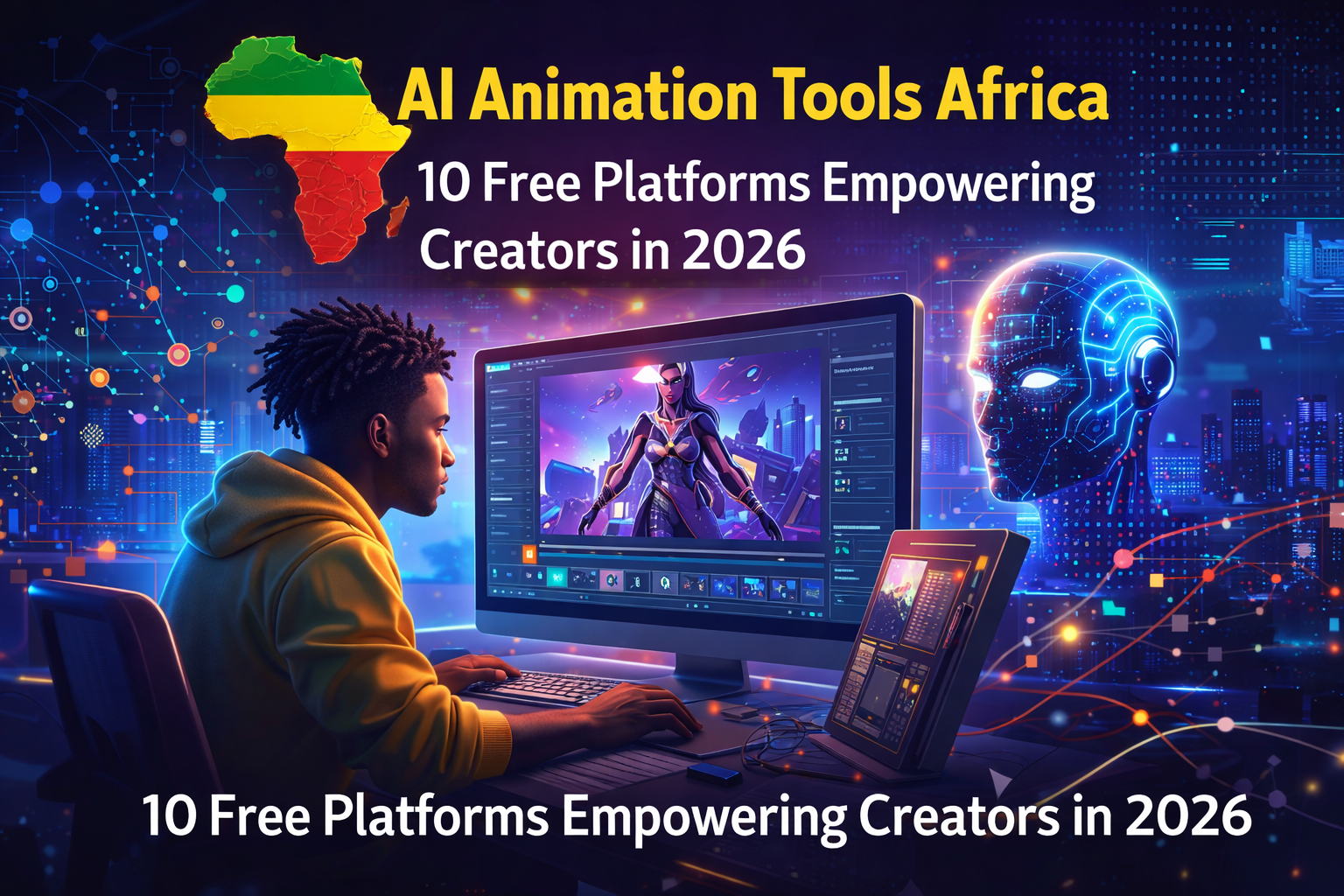
This isn’t a dream scenario for 2030. In fact, this is happening right now across Africa in 2026, powered by AI animation tools that Africa-based creators are rapidly adopting to bypass traditional animation barriers.
From Nairobi to Cape Town, from Lagos to Accra, African creators are leveraging free AI animation tools to bypass traditional barriers and compete on the global stage. The results? Kenya’s @tunero_animations won TikTok’s Rising Star of the Year award in 2025. Nigeria’s animation industry, valued at over $100 million, is growing at a 20% CAGR. Disney, Netflix, and Cartoon Network are actively commissioning African-led animated content.
The African animation market, valued at $14.52 billion in 2024, is projected to reach $15.71 billion in 2025, and AI animation tools are accelerating that growth by democratizing access to production-quality animation capabilities. Specifically, these tools have eliminated the cost, training, and hardware barriers that historically kept talented African storytellers from bringing their visions to life. As our comprehensive guide explores, AI in Africa is reshaping creative industries from animation to music production, enabling creators to compete globally.
In this comprehensive guide, we’ll explore the 10 best free AI animation tools that African creators are using in 2026 to build careers, tell authentic stories, and claim their space in the global animation economy. Whether you’re a complete beginner or an experienced animator looking to speed up your workflow, these AI animation tools can transform your creative vision into reality.
Why AI Animation Tools Matter for African Creators in Africa
Quick Verdict: Top AI Animation Tools for Different Needs
- Best for beginners: Animaker, Canva Magic Media
- Best for cinematic work: Runway ML, Sora 2
- Best on mobile: Kling AI
- Best for social content: Pika Labs, InVideo AI
- Best for 3D animation: Krikey AI
- Best for talking heads: HeyGen
- Best budget option: Start with Animaker Free, upgrade to Runway Standard
Before diving into the tools, let’s understand why this moment is so significant for Africa’s creative economy.
The African Animation Boom Is Real
The numbers tell a compelling story. Consequently, Africa’s creator economy was valued at $5.10 billion in March 2025 and is estimated to reach $29.84 billion by 2032, growing at a compound annual growth rate (CAGR) of 28.7%. Furthermore, animation sits at the heart of this explosion, with AI animation tools making it easier than ever for African creators to participate.
Over 100 animated films and TV shows featuring African stories are now produced annually, compared to just a handful a decade ago. Additionally, major productions like Iwájú (Disney+), Kizazi Moto: Generation Fire (Disney+), Supa Team 4 (Netflix), and Iyanu (Showmax) have proven that African animation resonates globally when given the platform.
Traditional Barriers Are Falling Thanks to AI Animation Tools
Historically, African animators faced three massive obstacles:
- Cost: Professional animation software like Adobe After Effects, Toon Boom, or Autodesk Maya costs hundreds or thousands of dollars annually, which is prohibitive for most African creators.
- Training: Similarly, animation degrees or specialized training programs were scarce and expensive across the continent.
- Hardware: Likewise, high-end computers capable of running professional animation software were out of reach for most.
AI animation tools in 2026 have shattered all three barriers. Specifically, cloud-based platforms require no expensive software licenses. Moreover, AI-powered automation replaces years of technical training. And most AI animation tools run smoothly on mid-range devices accessible to the average African creator.
The Mobile-First Advantage
Africa is the world’s most mobile-first continent. With 91% of gamers identifying mobile devices as their primary platform, and similar trends across content creation, AI animation tools that work on smartphones or lightweight devices have a massive advantage.
This aligns perfectly with how African creators actually work, often from phones or entry-level laptops, leveraging affordable data plans, creating content in co-working spaces or even from home.
The 10 Best Free AI Animation Tools in Africa for Creators (2026)
1. Runway ML: The Industry Standard for AI Animation Tools
Best For: Professional-quality cinematic animations, text-to-video, image-to-video
Runway ML has evolved from an experimental tool into the industry standard for AI-powered video and animation generation. In 2026, it’s the AI animation tool that professional studios, indie filmmakers, and solo African creators alike turn to for high-quality results.
What Makes It Special:
Gen-4.5 Model (Latest): Released in November 2025, Runway’s Gen-4.5 represents a massive leap forward in character consistency and motion quality. Notably, according to Runway’s research team, Gen-4.5 can maintain consistent character appearance across multiple scenes, solving the “character drift” problem that plagued earlier AI animation tools.
Act-Two Motion Capture: Traditional motion capture requires expensive equipment and studios. Runway’s Act-Two (July 2025) democratized mocap; you simply upload a performance video from any camera (including smartphones), and the AI captures facial expressions, body movements, and gestures to transfer to animated characters.
Workflows Feature: Released in October 2025, Workflows allows creators to chain multiple AI operations into automated pipelines. Generate video → apply edits → export in multiple formats, all as one automated process.
Realistic Use Case for African Creators:
A Nigerian filmmaker could use Act-Two to capture traditional Yoruba dance movements using just a smartphone, then transfer those performances to animated characters in an Afrofuturistic short film—all without leaving Lagos or renting a mocap studio.
Pricing for Africans:
- Free tier: Limited credits to test features
- Standard Plan: $12/month (~₦18,600) – 625 credits
- Pro Plan: $28/month (~₦43,400) – 2,250 credits
- Unlimited Plan: $76/month (~₦117,800) – Unlimited Standard generations
Where to Access: runwayml.com
Downsides:
- The credit system can burn fast during iteration
- Requires a stable internet connection
- Best results need prompt refinement skills
Pro Tip: Runway ML is one of several powerful AI tools African creators are adopting. For a complete overview of tools beyond animation, check out our guide on the best AI tools for Africans in 2025.
2. Animaker: The Beginner-Friendly AI Animation Tool
Best For: Explainer videos, educational content, social media animations, beginners
Animaker has positioned itself as the most user-friendly AI animation platform for creators who want professional results without a steep learning curve.
What Makes It Special:
Zero Learning Curve: Drag-and-drop interface with pre-made templates means you can create your first animation in minutes, not weeks.
Character Builder: Create custom animated characters that look like you or represent African features, skin tones, and cultural attire, something many Western animation tools overlook.
AI Voice Generator: Generate voiceovers in multiple languages and accents, including African-accented English, for authentic storytelling.
Asset Library: Thousands of pre-made characters, props, backgrounds, and music tracks, many of which can be customized to reflect African settings.
Realistic Use Case for African Creators:
A Kenyan educator could create animated explainer videos for students teaching Swahili grammar, with characters wearing traditional Maasai attire and backgrounds depicting Nairobi landscapes, all within Animaker’s library or customization options.
Pricing for Africans:
- Free Plan: Watermarked exports, 5 downloads/month
- Basic: $10/month (~₦15,500) – HD exports, no watermark
- Starter: $19/month (~₦29,450) – More features
- Pro: $49/month (~₦75,950) – Full feature access
Where to Access: animaker.com
Downsides:
- Free plan includes a watermark
- Advanced features require paid plans
- Less “AI magic” than pure generative tools
3. Sora 2 (OpenAI): The Cinematic Powerhouse
Best For: High-end cinematic visuals, realistic motion, sound integration
OpenAI’s Sora 2, launched on September 30, 2025, represents one of the most significant leaps in AI video generation. According to industry reviews, Sora 2 delivers top-tier realism with improved physics accuracy.
What Makes It Special:
Physical Accuracy: Objects move like real objects. Water flows realistically. Characters interact with their environment in believable ways.
Built-in Sound Effects and Dialogue: Unlike most AI video tools, Sora 2 can generate synchronized sound effects and even dialogue (when available), creating a more complete cinematic experience.
Remix and Storyboard Tools: Provides unprecedented control for creators who want to refine specific aspects of generated videos.
Realistic Use Case for African Creators:
A South African content creator developing an Afrofuturist short film could use Sora 2 to generate establishing shots of futuristic Johannesburg skylines, complete with ambient city sounds and realistic lighting—material that would cost thousands to produce traditionally.
Pricing for Africans:
- Access through ChatGPT Plus: $20/month (~₦31,000)
- Credit-based system for video generation
- Pricing structure evolving rapidly
Where to Access: openai.com/sora (via ChatGPT Plus)
Downsides:
- Takes creative liberties with vague prompts
- Struggles with highly dynamic sustained movement
- No built-in video editing tools
- Can require multiple iterations
4. Kling AI: The Action Specialist
Best For: Action sequences, sustained motion, extended videos
Kling AI has carved out a unique position as the go-to tool for animations requiring sustained physical movement, running, flying, fighting, and dancing.
What Makes It Special:
Superior Physics Simulation: Kling has demonstrated better physics than competitors, making action sequences look more realistic.
Longer Video Length: Can generate videos up to 2 minutes long (significantly longer than most competitors’ 5-10 second limits).
Mobile-Optimized Interface: The app interface is designed for creators working from phones and tablets, not just desktop computers, making it perfect for Africa’s mobile-first creative economy.
3-Minute Extend Feature: Strategically useful for sequences requiring one continuous camera move or uninterrupted action.
Realistic Use Case for African Creators:
A Nigerian animator creating a superhero character based on Yoruba mythology could use Kling to generate extended action sequences of the character flying over Lagos, fighting antagonists, or performing complex martial arts, all with realistic physics and sustained motion.
Pricing for Africans:
- Free tier available with limited credits
- Paid plans starting around $10/month (~₦15,500)
Where to Access: klingai.com
Downsides:
- Dialogue shots can be challenging
- Camera discipline is less refined than Runway
- Still requires a shot-by-shot approach for best results
5. InVideo AI: The Content Repurposing Master
Best For: Turning scripts/blogs into videos, social media content, marketing videos
InVideo AI specializes in transforming text-based content into polished video presentations, ideal for African creators building YouTube channels, educational platforms, or marketing content.
What Makes It Special:
Text-to-Video Excellence: Paste a blog post, article, or script, and InVideo AI generates a complete video with relevant stock footage, transitions, text overlays, and music.
Multi-Language Support: Generate videos in multiple languages, making it easier to reach pan-African audiences or diaspora communities.
Fast Generation: Videos typically generate in under a minute.
Stock Library Integration: Automatically pulls relevant stock footage and images to match your narrative.
Realistic Use Case for African Creators:
A Ghanaian tech blogger could convert written articles about African startups into engaging video content for YouTube and LinkedIn, complete with relevant footage, without filming anything themselves.
Pricing for Africans:
- Free Plan: Credits renew weekly, but exports include a watermark
- Plus: $20/month (~₦31,000) – Watermark-free
- Max: $48/month (~₦74,400) – Advanced features
Where to Access: invideo.io
Downsides:
- The free plan watermark can be limiting
- Best for presentation/explainer style, not cinematic animation
- Limited customization compared to pure animation tools
📊 Quick Comparison: First 5 Tools at a Glance
| Tool | Best Use | Price (Free Tier) | Learning Curve | African Creator Fit |
|---|---|---|---|---|
| Runway ML | Cinematic quality | Limited credits | Medium | ⭐⭐⭐⭐⭐ |
| Animaker | Beginners/Explainers | 5 downloads/mo | Very Easy | ⭐⭐⭐⭐⭐ |
| Sora 2 | High-end realism | Via ChatGPT Plus | Medium | ⭐⭐⭐⭐ |
| Kling AI | Action sequences | Limited credits | Easy-Medium | ⭐⭐⭐⭐⭐ |
| InVideo AI | Blog-to-video | Credits renew weekly | Easy | ⭐⭐⭐⭐ |
6. Luma AI (Dream Machine): The Smooth Motion Specialist
Best For: Smooth camera movements, polished transitions, photorealistic rendering
Luma Dream Machine has built a reputation for generating exceptionally smooth camera motion and polished visual transitions.
What Makes It Special:
Camera Control: Provides fine-grained control over camera movements, pans, zooms, and tracking shots.
Photorealistic Output: Particularly strong at generating realistic lighting, shadows, and textures.
Consistent Quality: Less variance in output quality compared to some competitors.
Realistic Use Case for African Creators:
A Kenyan real estate marketer could use Luma to generate photorealistic fly-through animations of property developments, showing apartments, amenities, and neighborhood views, all from architectural plans or reference images.
Pricing for Africans:
- Free tier: Limited monthly credits
- Pro plans starting
$10/month (₦15,500)
Where to Access: lumalabs.ai
Downsides:
- Shorter video lengths than some competitors
- Best for specific use cases rather than all-purpose animation
- Can struggle with complex character animations
7. Pika Labs: The Rapid Iteration Tool
Best For: Quick tests, style exploration, iterative workflows, social media content
Pika Labs focuses on speed and experimentation, making it ideal for creators who want to test multiple animation styles quickly.
What Makes It Special:
Speed: Generates animations faster than most competitors, enabling rapid iteration.
Style Flexibility: Easy to experiment with different artistic styles, such as realistic, cartoon, anime, and abstract.
Cost-Effective: Generally cheaper per generation than premium tools like Runway.
Community-Driven: Active Discord community sharing prompts, tips, and techniques.
Realistic Use Case for African Creators:
A Nigerian social media content creator could rapidly generate multiple versions of short-form content for TikTok, Instagram Reels, and YouTube Shorts, testing different visual styles to see what resonates with their audience.
Pricing for Africans:
- Free tier available
- Standard: $8/month (~₦12,400)
- Pro: $28/month (~₦43,400)
Where to Access: pika.art
Downsides:
- Outputs are less polished than Runway or Sora
- Better for experimentation than final professional work
- Limited advanced control features
8. HeyGen: The AI Avatar Specialist
Best For: Talking head videos, presentations, educational content, corporate communications
HeyGen revolutionized AI avatars, allowing creators to generate realistic talking head videos without filming.
What Makes It Special:
Custom Avatars: Create an AI version of yourself that speaks in your voice and mimics your mannerisms.
Multi-Language Lip Sync: Your avatar can speak in multiple languages with perfectly synchronized lip movements.
Studio-Quality Output: Professional lighting, clean backgrounds, polished presentation.
Realistic Use Case for African Creators:
A South African online course instructor could create an entire educational series using their AI avatar, speaking in English, Zulu, and Afrikaans, scaling content creation without repeatedly filming themselves.
Pricing for Africans:
- Free Plan: 1 minute of credit
- Creator: $29/month (~₦44,950) – 15 minutes/month
- Business: $89/month (~₦137,950) – 90 minutes/month
Where to Access: heygen.com
Downsides:
- Most expensive tool on this list for meaningful usage
- Focuses only on talking avatars (limited use case)
- Custom avatar training requires multiple shots
- Not user-friendly for non-technical users
9. Krikey AI: The 3D Animation Specialist
Best For: 3D character animation, gaming assets, 3D storytelling
Krikey AI specializes in 3D animation, allowing creators to generate animated 3D characters and scenes.
What Makes It Special:
3D Focus: While most AI animation tools focus on 2D or video, Krikey generates actual 3D assets.
Character Rigging: Automatically rigs 3D characters for animation.
Gaming Integration: Outputs compatible with game engines like Unity and Unreal.
Motion Library: Pre-built motion templates for common actions (walking, running, dancing).
Realistic Use Case for African Creators:
A Nigerian game developer building a mobile game featuring African mythology characters could use Krikey to generate and animate 3D models of deities, heroes, and creatures, significantly faster than traditional 3D modeling. As gaming and animation increasingly converge in Africa’s creative economy, tools like Krikey bridge both worlds. For more on this intersection, explore our analysis of AI-generated worlds and gaming career opportunities for African youth.
Pricing for Africans:
- Free Plan: Limited features and exports
- Pro: Starting at $15/month (~₦23,250)
Where to Access: krikey.ai
Downsides:
- Steeper learning curve than 2D tools
- Outputs may require additional polishing
- Less mature than established 3D animation software
10. Canva Magic Media (AI Video): The All-in-One Creative Suite
Best For: Social media graphics with animation, simple motion graphics, brand content
Canva has integrated AI video generation into its already popular design platform, making it seamless for creators already using Canva for graphics.
What Makes It Special:
Integrated Workflow: Generate AI animations within the same platform you use for social media graphics, presentations, and branding.
Template-Based: Thousands of pre-designed templates with AI enhancements.
Brand Kit Integration: Automatically applies your brand colors, fonts, and logos to AI-generated content.
Collaboration Features: Team collaboration and approval workflows are built in.
Realistic Use Case for African Creators:
A Kenyan social media manager for a pan-African brand could create consistent animated social media content across platforms, posts, stories, reels, all branded correctly and generated quickly using Canva’s AI tools alongside traditional design features.
Pricing for Africans:
- Free Plan: Basic features, watermarked
- Canva Pro: $12.99/month (~₦20,133) – Full AI features
- Canva for Teams: $14.99/user/month (~₦23,233)
Where to Access: canva.com
Downsides:
- AI features are less advanced than specialized tools
- Better for simple animations than complex cinematic work
- Requires Canva Pro for best results
Complete Tool Roundup: Which Should You Choose?
If you’re just starting: Animaker or Canva (easiest, free tiers)
If you want cinematic quality: Runway ML or Sora 2
If you’re on mobile often: Kling AI
If you create social media content: Pika Labs or InVideo
If you need 3D for gaming: Krikey AI
If you teach/present: HeyGen or InVideo
If budget is tight: Start free with Animaker → upgrade to Runway when earning
💡 Pro Strategy: Most successful African creators use 2-3 tools in combination rather than relying on just one.
How African Creators Are Using AI Animation Tools Strategically
Theory is one thing. Real-world application is another. Consequently, here’s how African animators and creators are strategically combining these AI animation tools to build careers and businesses.
The Hybrid Workflow Strategy
Most successful African creators don’t rely on just one AI animation tool. Instead, they use a strategic combination:
Phase 1: Concept and Storyboarding
- First, use Runway or Sora to generate quick concept visuals
- Next, test different styles rapidly with Pika Labs
- Finally, refine the storyboard using Canva or Animaker
Phase 2: Character and Asset Creation
- Initially, generate 3D characters with Krikey
- Then, create consistent 2D characters with Neolemon (a specialized tool for character consistency)
- Subsequently, build brand-specific avatars with HeyGen
Phase 3: Animation Production
- Use Runway Gen-4.5 for cinematic shots
- Employ Kling for action sequences
- Additionally, leverage Luma for smooth camera work
Phase 4: Post-Production and Distribution
- Edit and combine clips using free tools like DaVinci Resolve
- Meanwhile, add voiceovers with AI voice tools
- Optimize for social media using InVideo or Canva
Phase 5: Monetization
- Upload to YouTube (ad revenue)
- License content to African streaming platforms
- Offer animation services to brands
- Furthermore, create online courses teaching animation
Real Success Stories
@tunero_animations (Kenya): Won TikTok’s Rising Star of the Year in 2025 by creating culturally relatable animated characters that resonate with East African audiences. Uses a combination of traditional animation techniques and AI assistance.
Triggerfish Animation Studios (South Africa): While a professional studio, Triggerfish has integrated AI tools into their workflow to speed up pre-production and concept development for projects like Kizazi Moto: Generation Fire on Disney+.
Nigerian YouTube Animators: Channels like those producing Yoruba and Pidgin-language animated content are collectively amassing millions of views by combining AI-generated assets with culturally specific storytelling.
For a broader context on how African creators are leveraging digital tools, explore our guide on the best AI tools for Africans 2025.
Practical Tips for African Creators Starting with AI Animation Tools
1. Start With What You Have
You don’t need a high-end computer. Fortunately, most of these AI animation tools work in web browsers or on modest hardware. Therefore, start with the free tiers of Runway, Animaker, or Canva and learn the basics before investing money.
2. Focus on African Stories
This is your competitive advantage. Indeed, global platforms are actively seeking authentic African narratives. Tools like Iyanu (Yoruba mythology), Kizazi Moto (Afrofuturism), and Iwájú (Nigerian culture) succeeded because they told distinctly African stories that hadn’t been told before.
Specifically, use AI animation tools to bring African myths, legends, contemporary urban stories, and cultural experiences to life in ways that resonate globally.
3. Learn Prompt Engineering
The quality of your AI-generated animation depends heavily on how well you prompt the AI. Consequently, invest time learning:
- How to describe visual styles clearly
- How to specify camera movements
- How to maintain consistency across scenes
- How to iterate and refine prompts
Importantly, this skill is free to develop and dramatically improves results.
4. Build a Portfolio on Social Media
Don’t wait to have a “perfect” demo reel. Rather, start posting short animations on TikTok, Instagram, and YouTube immediately. Test what resonates. Build an audience. Ultimately, social proof matters more than perfection when you’re starting out.
5. Collaborate With Other African Creators
Join communities of African animators on Discord, WhatsApp, and Telegram. Additionally, share tips, collaborate on projects, and support each other. The African creator economy thrives on community, not isolation.
6. Monetize Early
Don’t wait until you’re “good enough.” Instead, start offering simple animation services to small businesses, NGOs, or educational institutions. Even basic explainer videos or social media content can generate income while you’re still learning.
For strategies on monetizing creative skills in Africa, check out how to use AI tools to earn money in Africa 2026.
Overcoming Common Challenges with AI Animation Tools in Africa
Challenge 1: Internet Connectivity
Solution: Download reference materials and assets when you have good connectivity. Meanwhile, work offline on scripts and storyboards. Use AI animation tools with offline capabilities where possible. Fortunately, many Nigerian and Kenyan co-working spaces offer reliable WiFi specifically for creators.
Challenge 2: Payment Methods
Solution: Many of these platforms now accept local payment methods. Specifically, Paystack, Flutterwave, and mobile money integrations are becoming standard. For international payments, services like Grey, Chipper Cash, or virtual dollar cards work well.
Challenge 3: Learning Curve
Solution: Focus on one AI animation tool at a time. Additionally, YouTube has extensive free tutorials. Many African creators share free courses and guides specifically for local audiences. Therefore, start with the most beginner-friendly tool (Animaker or Canva) before advancing to more complex platforms like Runway.
Challenge 4: Data Costs
Solution: Cloud-based AI animation tools are relatively data-efficient compared to downloading large software. Moreover, work during off-peak hours when data costs are lower. Many universities and tech hubs offer free WiFi to creative communities.
The Future of AI Animation Tools in Africa (2026-2028)
The trajectory is clear: AI animation tools will only get better, cheaper, and more accessible. Specifically, here’s what’s coming:
More African-Specific Features
Tool companies are waking up to Africa’s massive creator market. Therefore, expect:
- African language support in AI voiceover tools
- Character libraries featuring diverse African skin tones, features, and cultural attire
- Templates and presets designed for African storytelling aesthetics
- Payment integrations with African fintech platforms
Improved Offline Capabilities
Recognizing connectivity challenges, future AI animation tools will offer:
- Better offline modes
- Lower data consumption
- Hybrid cloud-local processing
Greater Integration with Traditional Animation
AI won’t replace traditional animation skills; rather, it will augment them. Consequently, the future belongs to creators who combine:
- Traditional African storytelling techniques
- Hand-drawn or 3D animation fundamentals
- AI animation tools for speed and scale
- Cultural authenticity and creative vision
Industry Growth
The African animation market is projected to grow from $15.71 billion in 2025 to potentially $20+ billion by 2028. This growth creates:
- More jobs for African animators
- More funding for African animation studios
- More global distribution deals
- More training programs and educational opportunities
For broader trends in African tech innovation, see our analysis of AI innovation in Africa: job risks vs growth 2025.
Frequently Asked Questions
1. Do I need animation experience to use these AI animation tools?
No. Indeed, that’s the revolutionary aspect of AI animation tools in 2026. Platforms like Animaker, InVideo, and Canva are designed for complete beginners. While animation experience helps you get better results faster, it’s not required to start creating.
However, understanding basic storytelling, composition, and visual language will significantly improve your output, skills you can learn for free through YouTube tutorials.
2. Which AI animation tool is best for someone starting from zero in Nigeria or Kenya?
Start with Animaker or Canva Magic Media. Specifically, both have:
- Free tiers to learn without financial risk
- Drag-and-drop interfaces (no coding or technical skills)
- Extensive template libraries
- Tutorials specifically for beginners
- Relatively low data usage
Once comfortable, graduate to Runway or Sora for more advanced cinematic work.
3. Can I use these tools professionally for client work?
Yes, but check each tool’s licensing terms. Most paid plans include commercial rights, meaning you can:
- Create animations for clients
- Monetize content on YouTube
- Sell animation services
- Use in advertising and marketing
Free plans often have restrictions, so upgrade to paid plans when doing commercial work to ensure you have proper licensing.
4. How do these tools handle African cultural elements?
This varies by tool:
Good for African representation:
- Animaker: Customizable characters with diverse features
- Krikey: 3D characters can be designed from scratch
- Runway: Generates based on your specific prompts and reference images
Limited by default libraries:
- Stock-based tools may have fewer African-specific assets
- Solution: Upload your own reference images or describe African settings specifically in prompts
The AI animation community is actively advocating for better representation in default libraries.
5. What about copyright and ownership of AI-generated content?
This is evolving, but generally in 2026:
Most platforms (Runway, Animaker, etc.) grant you ownership of content you create using their tools on paid plans. However, you should:
- Read each platform’s terms of service carefully
- Understand restrictions on free vs. paid tiers
- Keep documentation of your creative process
- Add your own creative input (don’t just generate and publish—edit, combine, enhance)
For African creators entering international markets, understanding IP rights is crucial.
6. Can these tools help me break into international animation markets?
Absolutely. Success stories like:
- Iwájú (Nigerian creators, Disney+ global distribution)
- Kizazi Moto (Pan-African project, Disney+ in 100+ countries)
- Supa Team 4 (Zambian creator, Netflix global release)
All demonstrate that authentic African stories delivered with professional quality find global audiences. AI tools help African creators achieve that professional quality faster and cheaper than ever before.
7. What computer specs do I need?
Minimum for cloud-based tools:
- 4GB RAM
- Reliable internet connection (even mobile data works)
- Modern web browser (Chrome, Safari, Firefox)
- Basic smartphone for some mobile-optimized tools
Ideal setup:
- 8GB+ RAM
- Stable broadband connection
- Mid-range laptop (₦150,000-₦300,000 range)
- External storage for project files
Most tools are cloud-based, so processing happens on their servers, not your device. Your computer just needs to run a web browser smoothly.
8. How long does it take to learn these tools?
Timeline varies by tool:
Week 1-2:
- Animaker, Canva: Basic competence within days
- Can create simple animations immediately
Weeks 3-4:
- InVideo, Pika: Understand workflows
- Start producing usable content
Months 1-3:
- Runway, Sora, Kling: Master prompting techniques
- Develop consistent style and quality
- Build a portfolio of work
Months 3-6:
- Professional-level proficiency
- Can offer paid services confidently
- Understand advanced workflows
Consistency matters more than intensity. Daily practice for 30-60 minutes beats sporadic marathon sessions.
9. Can I combine traditional animation with AI tools?
Yes! The best African animators do exactly this. Workflow examples:
Hybrid Approach 1:
- Hand-drawn character designs (traditional)
- Use Krikey to 3D model and rig them (AI)
- Animate keyframes traditionally
- Use AI to fill in-between frames
Hybrid Approach 2:
- Storyboard by hand
- Generate background environments with Runway
- Animate characters traditionally
- Composite everything together
This hybrid approach often produces the most culturally authentic and visually distinctive work.
10. Are there any African-specific animation platforms or communities?
Yes, the African animation community is growing rapidly:
Studios and Collectives:
- Triggerfish Animation Studios (South Africa)
- Kugali (Pan-African)
- Magic Carpet Studios (Nigeria)
- Fatboy Animations (Kenya)
- Sparrow Productions (Nigeria)
Training Programs:
- Triggerfish Academy (mentorship across Nigeria, Kenya, Rwanda)
- African Animation Network
- University programs in South Africa, Nigeria, Kenya
Online Communities:
- African Animation WhatsApp/Telegram groups
- TikTok: #AfricanAnimation hashtag community
- YouTube: African animator channels and tutorials
For more on Africa’s growing tech and creative communities, explore our coverage of ecosystem trends.
📝 About the Author
Originally written by Bold & Beautiful Creators
Reviewed and updated in 2026 by Dabit Samuel — SEO Specialist & WordPress Developer at Creative Tech Africa.
Dabit covers AI tools, the creator economy, and digital skills development across Africa, with a focus on helping Nigerian, Kenyan, and South African creators leverage emerging technologies to build sustainable careers.
Connect: For questions about AI animation tools or creator opportunities in Africa, reach out via Creative Tech Africa.
Key Takeaways
AI animation tools in 2026 have fundamentally democratized animation creation for African creators. Furthermore, the barriers that once kept talented storytellers from bringing their visions to life, such as expensive software, specialized training, and powerful hardware, have largely disappeared.
The tools exist. The market exists. The opportunity exists.
From Runway’s cinematic Gen-4.5 to Animaker’s beginner-friendly interface, from Sora’s photorealistic generation to Krikey’s 3D capabilities, African creators now have access to the same AI animation tools used by professional studios worldwide.
The African animation market, valued at $15.71 billion in 2025 and growing at double-digit rates, is hungry for authentic African stories told by African creators. Moreover, Disney, Netflix, Cartoon Network, and Showmax are actively commissioning African content. Global audiences want to see African mythology, contemporary African experiences, and Afrofuturist visions.
What’s missing isn’t technology. Rather, its creators are willing to take the first step.
Consequently, start with one AI animation tool. Create one short animation. Share it on social media. Learn from feedback. Iterate. Improve. Build a portfolio. Connect with other creators. Offer services. Tell your stories.
The African animation revolution isn’t coming; it’s already here. The question is: will you be part of it?
Ready to dive deeper into how AI is transforming Africa’s creative economy? Explore our comprehensive AI in Africa — The Complete Guide to discover how animation fits into the broader AI revolution reshaping every industry across the continent.
Continue Your Creative Journey
- AI in Africa — The Complete Guide — How AI is transforming every creative industry across the continent
- How to Use AI Tools to Earn Money in Africa 2026 — Monetization strategies for creators
- The Future of Gaming: AI-Generated Worlds and Career Opportunities for African Youth — Gaming meets animation
- Best AI Tools for Africans 2025 — Beyond animation
- AI Innovation in Africa: Job Risks vs Growth 2025 — Career opportunities in Africa’s creative economy
- AI Tools Transforming African Classrooms 2025 — Educational applications
- Ecosystem Trends — Stay current on African creative tech developments
- Use Cases — Real-world applications of AI tools in Africa

1 comment
Impressive content definitely trying out the loom crafter