Introduction: Nigerian Startups Are Embracing AI Tools to Transform Their Business
“We cut costs by 67% and tripled our output.” That’s what happens when Nigerian startups using AI tools get serious about automation.
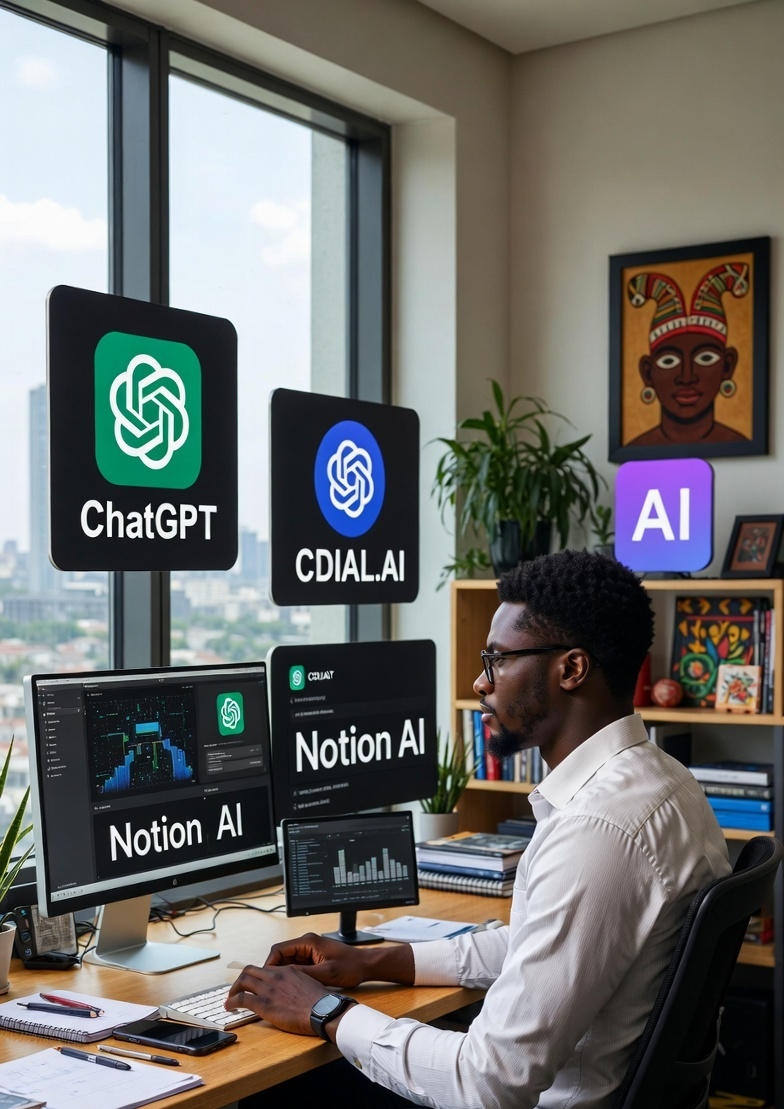
Nigerian startups using AI tools are revolutionizing how they operate in 2025. From Lagos tech hubs to Abuja innovation centers, founders are leveraging artificial intelligence to automate customer service, create content, and scale operations, all without breaking the bank. While your competitors deploy chatbots handling 200 daily inquiries, are you still answering the same questions manually?
At Creative Tech Africa, we’ve tracked this transformation closely as part of our broader AI in Africa initiative. What started as experimental AI adoption has become essential for survival. The gap is widening: startups using AI report 18-25% productivity gains, they’re scaling without proportional headcount increases, and most tools cost less than ₦30,000/month.
In this comprehensive guide, you’ll discover exactly how Nigerian startups are using AI tools to boost productivity, cut costs, and gain competitive advantages, and real-world AI use cases that you can implement today, not someday.
What you’ll learn:
- 6 proven ways Nigerian startups use AI tools to save money and time
- Real case studies from Lagos, Abuja, and Port Harcourt startups
- Specific AI tools that accept Naira payments or offer free tiers
- Step-by-step implementation guide you can follow today
- 2025 data on AI adoption trends across Nigerian startups
Let’s dive into how AI is reshaping the Nigerian startup landscape.
Why Nigerian Startups Are Adopting AI Tools in 2026
AI adoption among Nigerian startups has exploded. According to the Africa AI Observatory’s 2025 report, 64% of Nigerian startups now use at least one AI-powered tool, up from just 38% in 2023.
The Business Case for AI in Nigerian Startups
Cost reduction: AI tools replace repetitive manual tasks that previously required full-time staff. A Lagos fintech startup saved ₦300,000 monthly by automating content creation with ChatGPT.
Speed and efficiency: Tasks like design, marketing, and data entry that took hours now take minutes. Nigerian startups using AI tools report 18-25% average productivity gains.
Scalability without headcount: Founders can serve more customers without proportionally increasing staff costs. This is crucial in Nigeria’s challenging economic climate.
Mobile accessibility: Modern AI tools work on smartphones with basic internet, making them accessible even during power outages or with limited infrastructure.
What Changed in 2025
Several factors accelerated AI tool adoption among Nigerian startups:
Naira payment options: Tools like CDIAL.AI and Xara AI now accept Naira, eliminating forex challenges.
Offline capabilities: New tools cache data locally, working during intermittent connectivity.
Local language support: AI platforms now understand Yoruba, Hausa, Igbo, and Nigerian Pidgin.
Lower barriers to entry: Free tiers and affordable paid plans make AI accessible to bootstrapped startups.
6 Proven Ways Nigerian Startups Use AI Tools to Save Money
Here are six proven AI use cases that Nigerian startups are implementing right now to cut costs and boost productivity:
1. Customer Support Automation with AI Chatbots
The challenge: Nigerian startup founders waste 5-10 hours weekly answering repetitive WhatsApp messages about pricing, delivery times, and product availability.
The AI solution: Intelligent chatbots trained on your business FAQs handle common questions 24/7, freeing founders to focus on sales and growth.
Best AI Chatbot Tools for Nigerian Startups
CDIAL.AI (₦8,000/month starter plan)
- Supports Yoruba, Hausa, and Igbo
- WhatsApp integration
- Works with low-bandwidth connections
- Perfect for: Rural-focused businesses, AgriTech startups
Chatbase (Free tier available, ₦15,000/month pro)
- Train on your website or documents
- Multilingual support
- Easy WhatsApp Business API integration
- Perfect for: E-commerce, SaaS startups
Tidio AI (₦10,000/month)
- Real-time website chat
- Email ticket management
- Simple setup, no coding required
- Perfect for: Service businesses, agencies
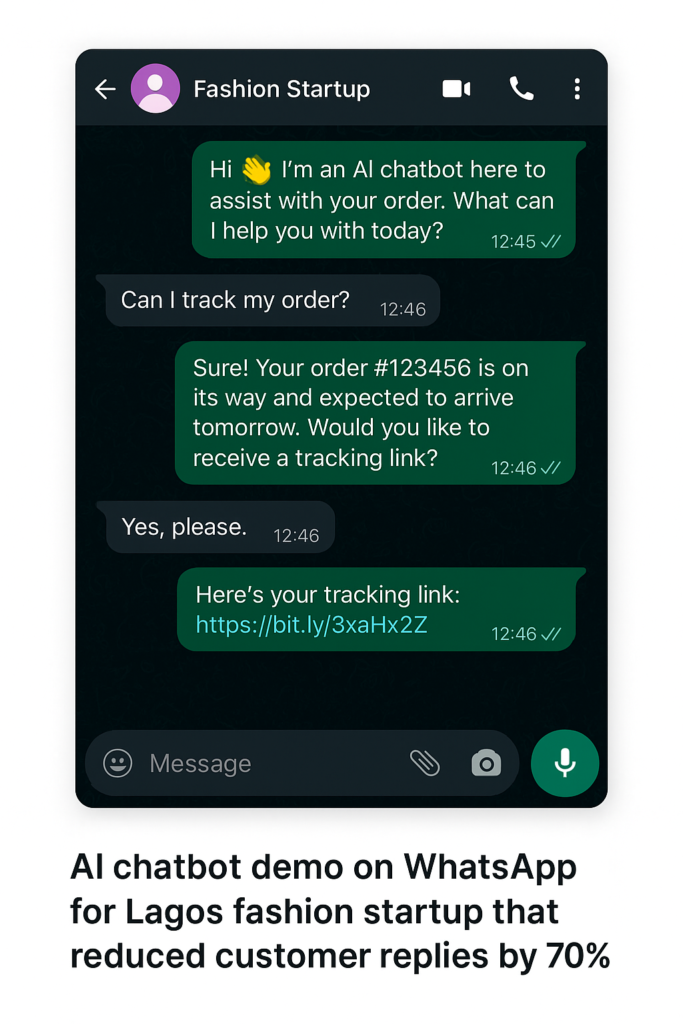
Real Example: Lagos Fashion Brand Saves 70% on Support Time
Startup: Adire Lagos (fashion e-commerce) Location: Yaba, Lagos Challenge: Receiving 200+ daily WhatsApp inquiries about sizes, shipping, and returns
Implementation:
- Collected 100 most common customer questions
- Trained Chatbase chatbot with product catalog and FAQs
- Integrated with WhatsApp Business API
- Set human handoff triggers for complex queries
Results after 2 months:
- 70% reduction in manual customer service time
- 2 full-time employees reassigned to sales
- 3x faster response times
- Customer satisfaction up 45%
Founder quote: “We went from drowning in messages to having time to grow. The chatbot handles basics so my team focuses on actual sales.”
Implementation Checklist: AI Customer Support
- Document your 50-100 most common customer questions
- Choose a chatbot tool (start with the free tier)
- Train the bot with your FAQs and product info
- Test with 10 real customers before full launch
- Set up “human handoff” triggers for complex issues
- Monitor bot accuracy weekly, retrain as needed
- Track time saved and customer satisfaction metrics
2. AI-Powered Content Creation & Marketing
The challenge: Nigerian startup marketing teams struggle to produce enough social media content, blog posts, and ad copy to stay competitive. Hiring writers is expensive.
The AI solution: AI writing tools generate first drafts of marketing content in minutes, which human teams then edit and personalize.
Best AI Content Tools for Nigerian Startups
ChatGPT (Free tier, ₦30,000/month for GPT-4)
- Blog posts, social media captions, email sequences
- Supports Nigerian English and Pidgin with proper prompting
- Browser-based, works on any device
- Perfect for: All content types
Writesonic (Free trial, ₦12,000/month)
- Pre-built templates for ads, blogs, and product descriptions
- Affordable compared to ChatGPT Plus
- Naira payment option available
- Perfect for: E-commerce product descriptions
Canva Magic Studio (Free tier, ₦8,000/month pro)
- AI image generation and editing
- Social media post templates
- Video creation with Magic Media
- Perfect for: Visual content, social media
Lumen5 (₦20,000/month)
- Converts blog posts to videos automatically
- Stock footage library included
- No video editing skills required
- Perfect for: Video marketing, YouTube content
Real Example: Abuja Fintech Saves ₦300,000 Monthly on Content
Startup: PayNaija (fintech platform) Location: Abuja Challenge: Needed daily Twitter content, weekly blog posts, monthly email newsletters—all requiring expensive freelance writers
Implementation:
- Created a content calendar with topics and keywords
- Used ChatGPT to generate first drafts (5-10 minutes per piece)
- Hired one editor to refine AI drafts for brand voice
- Used Canva AI for social media graphics
- Maintained human oversight for accuracy and tone
Results after 3 months:
- Cut content costs from ₦450,000 to ₦150,000 monthly
- 3x content output (from 12 to 36 posts/month)
- Twitter engagement increased 2.5x
- Email open rates improved 18%
Founder quote: “AI doesn’t replace our creativity, it amplifies it. We produce more content faster, and it still sounds like us.”
Pro Tips: AI Content Creation Best Practices
Never publish AI-generated content raw. Always edit for:
- Nigerian context and cultural references
- Brand voice and personality
- Factual accuracy (AI can hallucinate)
- Local SEO keywords
Use AI for first drafts, not final copy. The formula is:
- AI generates (20% of the time)
- Human edits (30% of time)
- Human adds personality/examples (50% of time)
Build a “prompt library.” Save your best ChatGPT prompts for:
- Twitter threads about fintech
- Product description templates
- Email subject lines that convert
- Blog post outlines for your industry
3. Productivity & Workflow Optimization
The challenge: Nigerian startup teams lose hours to unproductive meetings, scattered information, and manual task coordination.
The AI solution: AI-powered workspace tools summarize meetings, organize projects, and automate routine workflows.
Best AI Productivity Tools for Nigerian Startups
Notion AI (₦12,000/month per user)
- Summarizes meeting notes automatically
- Generates project templates and SOPs
- Database automation and smart search
- Perfect for: Remote teams, project management
ClickUp AI (₦10,000/month)
- Task automation and scheduling
- Project summary generation
- Team workload balancing
- Perfect for: Growing teams with multiple projects
Zapier (Free tier, ₦28,000/month pro)
- Connects 5,000+ apps without coding
- Automates repetitive workflows
- Triggers actions based on events
- Perfect for: Workflow automation across tools
Make (formerly Integromat) (Free tier, ₦15,000/month)
- Visual automation builder
- More complex workflows than Zapier
- Better for technical founders
- Perfect for: Advanced automation needs
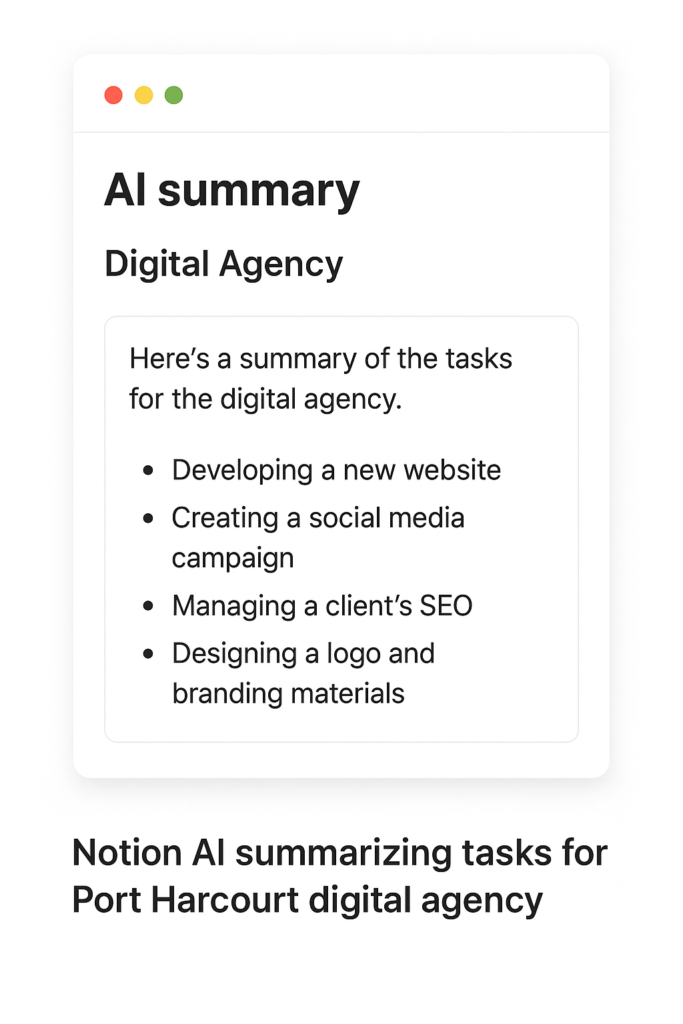
Real Example: Port Harcourt Agency Cuts Email Volume 40%
Startup: Digital Nomads NG (digital marketing agency) Location: Port Harcourt Challenge: Team of 8 drowning in internal emails, missed deadlines, and duplicate work
Implementation:
- Migrated all project docs to Notion
- Used Notion AI to auto-summarize weekly client meetings
- Set up Zapier workflows:
- New client → auto-create project template
- Task completed → notify team on Slack
- Invoice paid → update revenue dashboard
- Created “single source of truth” for all client info
Results after 1 month:
- Internal emails dropped 40%
- Meeting time reduced from 12 to 7 hours weekly
- Zero missed deadlines in 60 days
- Client satisfaction scores up 35%
Founder quote: “Notion AI became our ‘second brain.’ Everything’s organized, everyone’s aligned, and we actually have time to do the work.”
Implementation Guide: AI Productivity Stack
Week 1: Centralize information
- Choose one workspace tool (Notion or ClickUp)
- Move all docs, notes, and tasks there
- Create project templates
Week 2: Automate meetings
- Use Notion AI or ClickUp AI to summarize meetings
- Stop taking manual notes
- Share AI summaries immediately
Week 3: Connect your tools
- Use Zapier to link email, CRM, accounting, and Slack
- Automate 3 repetitive workflows
- Examples: Lead capture, invoice reminders, task assignments
Week 4: Measure and optimize
- Track time saved weekly
- Survey team satisfaction
- Identify next automation opportunities
4. Sales & Data Analytics Powered by AI
The challenge: Most Nigerian startups don’t analyze their data effectively. Founders make decisions based on gut feeling rather than insights.
The AI solution: AI analytics tools turn raw data into actionable insights—predicting customer behavior, forecasting revenue, and identifying growth opportunities.
Best AI Analytics Tools for Nigerian Startups
Google Looker Studio (Free)
- Connect Google Sheets, Analytics, and Ads
- AI-powered insights and anomaly detection
- Beautiful dashboards without design skills
- Perfect for: Startups with Google Workspace
QuickBooks + AI Features (₦25,000/month)
- Financial forecasting and cash flow prediction
- Automatic expense categorization
- Revenue trend analysis
- Perfect for: Financial data analysis
Durable AI Dashboard (₦8,000/month)
- No-code dashboard builder
- Predictive analytics for sales
- Customer behavior insights
- Perfect for: Non-technical founders
Glide AI (Free tier, ₦15,000/month)
- Turn spreadsheets into mobile dashboards
- Real-time data visualization
- Team collaboration features
- Perfect for: Mobile-first teams
Real Example: Lagos Logistics Startup Reduces Complaints 25%
Startup: QuickSend NG (same-day delivery) Location: Ikeja, Lagos Challenge: No visibility into delivery performance, frequent customer complaints about delays
Implementation:
- Connected order database to Looker Studio
- Built dashboard tracking:
- Average delivery time by route
- Driver performance metrics
- Peak demand hours
- Customer complaint patterns
- AI forecasting predicted high-demand days
- Adjusted driver schedules based on predictions
Results after 3 months:
- 25% reduction in late deliveries
- Customer complaints down 40%
- Revenue up 18% from better scheduling
- Data-driven decisions replaced guesswork
Founder quote: “We finally understand our business. The AI shows us what’s working, what’s not, and what to do next.”
Starter Analytics Stack for Nigerian Startups
Free tier setup:
- Google Sheets for data collection
- Google Looker Studio for visualization
- ChatGPT for data analysis questions
Monthly investment < ₦20,000:
- Track revenue, customers, and marketing spend
- Build 3 key dashboards: sales, marketing, operations
- Review metrics weekly, adjust strategy monthly
5. Recruitment & HR Automation
The challenge: Screening hundreds of job applications is time-consuming. Nigerian startup founders need efficient hiring processes.
The AI solution: AI recruitment tools shortlist candidates, suggest interview questions, and assess skills—cutting hiring time in half.
Best AI Recruitment Tools for Nigerian Startups
ChatGPT for CV Screening (Free tier available)
- Upload PDFs, ask “Which candidates best match this role?”
- Generate customized interview questions
- Summarize candidate strengths/weaknesses
- Perfect for: Small teams with occasional hiring
Manatal (₦18,000/month)
- AI candidate scoring and ranking
- Automated email sequences
- Integration with Nigerian job boards
- Perfect for: Frequent hiring needs
BreezyHR (₦22,000/month)
- CV parsing and candidate tracking
- Interview scheduling automation
- Team collaboration features
- Perfect for: Growing teams (5+ hires/year)
Real Example: Yaba Startup Cuts Time-to-Hire by 50%
Startup: EduTech NG (e-learning platform) Location: Yaba, Lagos Challenge: Receiving 300+ applications per role, taking 6 weeks to hire one person
Implementation:
- Used ChatGPT to screen initial applications
- Uploaded job description + all CVs
- Asked: “Rank the top 20 candidates and explain why.”
- Manually reviewed AI-shortlisted candidates only
- Used AI-generated interview questions
Results:
- Time-to-hire reduced from 6 weeks to 3 weeks
- HR team reviewed 20 candidates instead of 300
- Better quality hires (skills-matched)
- Saved 40 hours per hiring cycle
Pro tip: Always review AI recommendations. Use AI for shortlisting, not final decisions. Bias can exist in AI screening.
6. Local Language & Cultural Adaptation
The challenge: Many Nigerian startups serve customers who prefer communicating in Yoruba, Hausa, Igbo, or Pidgin—not just English.
The AI solution: Local language AI tools break down communication barriers, making services accessible to millions more Nigerians. This is one of the most impactful AI use cases in Africa.
Best Local Language AI Tools
CDIAL.AI (₦8,000/month)
- Native support for Yoruba, Hausa, and Igbo
- Voice and text chatbots
- Low-bandwidth optimized
- Perfect for: AgriTech, rural markets
Google Cloud Translation API (Pay-per-use, ~₦2,000/month for small volume)
- 100+ languages, including Nigerian languages
- Integrates with websites and apps
- Real-time translation
- Perfect for: Multilingual platforms
NLPCloud (₦10,000/month)
- Fine-tune models for the Nigerian context
- Sentiment analysis in local languages
- Custom AI training
- Perfect for: Tech-savvy teams
Real Startup Stories (2025 Highlights)
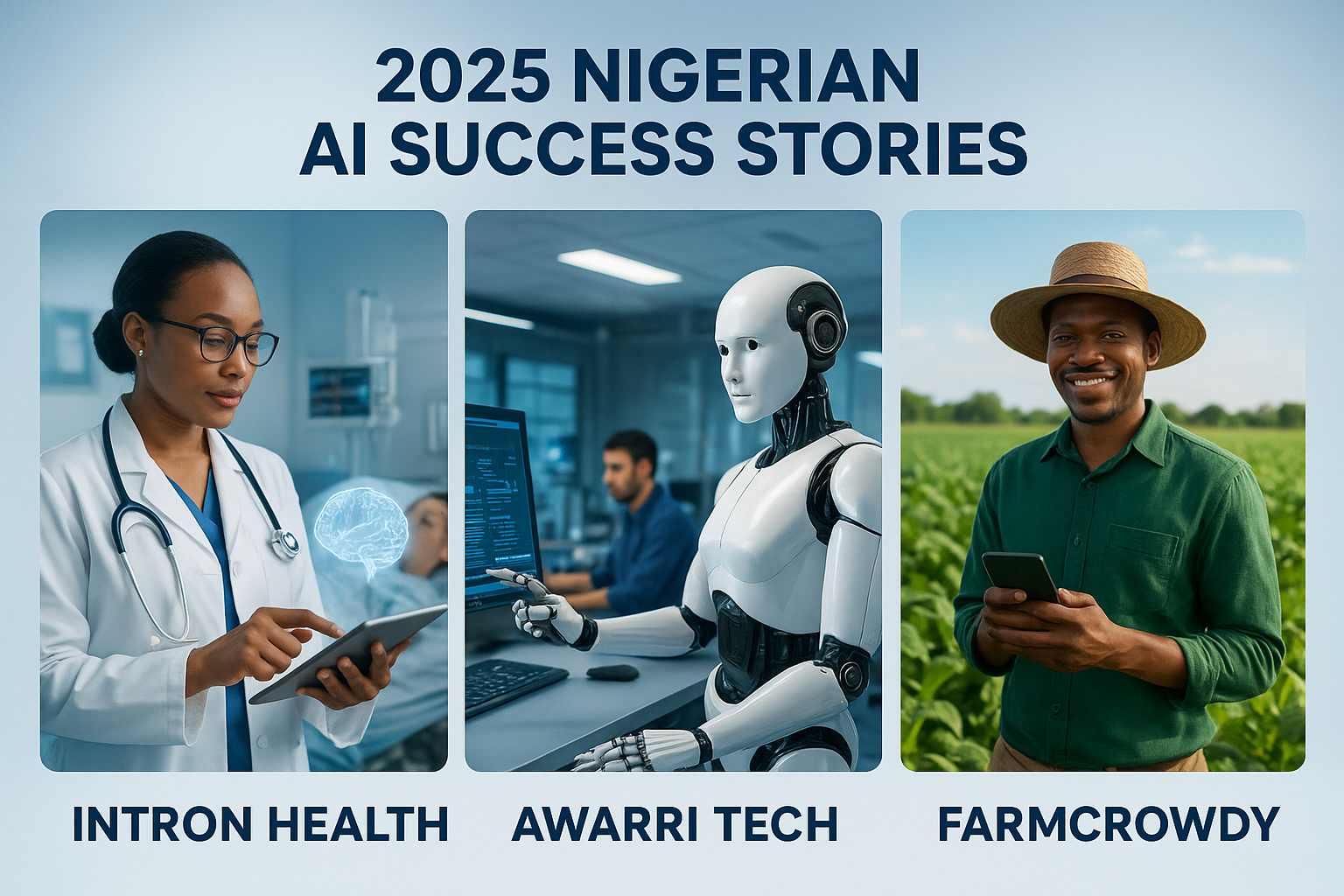
Case Study: Intron Health – Clinical AI for Nigerian Accents
Industry: HealthTech (Lagos)
The problem: Global medical transcription tools struggled with Nigerian doctor accents, leading to errors in patient records.
AI solution: Intron Health built a custom speech recognition AI trained on Nigerian English, Yoruba, and Igbo medical terminology.
Implementation:
- Recorded 1,000+ hours of Nigerian doctor consultations
- Fine-tuned speech models for medical context
- Integrated with hospital EMR systems
- Added offline mode for clinics with poor internet
2025 results:
- 92% transcription accuracy (up from 60% with global tools)
- 60% reduction in administrative time for doctors
- Deployed in 50+ clinics across Lagos, Abuja, and Kano
- Partnership with NITDA for national rollout
Why it’s unique: First AI tool specifically designed for the Nigerian healthcare context and accents.
Founder quote: “Global AI tools weren’t built for Africa. We’re building AI that understands how Nigerians actually speak.”
Case Study: Awarri Technologies – Robotics Education with Local Context
Industry: EdTech (Abuja)
The problem: Nigerian students learned coding with foreign examples that didn’t resonate culturally.
AI solution: AI-powered coding curriculum with Nigerian cultural context, plus affordable MekaMon robots.
Implementation:
- Created Pidgin-language coding lessons
- Built a chatbot assistant explaining concepts in Yoruba/Hausa
- Used local examples (Jollof rice recipe algorithms, Lagos traffic optimization)
- Made robots affordable for Nigerian schools (₦150,000 vs ₦500,000 imports)
2025 results:
- Deployed in 50+ Nigerian schools
- Student engagement up 35% vs traditional coding classes
- 2,000+ students built AI/robotics projects
- Part of Google’s 2025 Africa Accelerator cohort
Why it’s unique: First Nigerian EdTech to combine AI, robotics, and local language/culture.
What you can learn: Localization = competitive advantage. Nigerian founders who adapt global AI for the local context win.
Case Study: Farmcrowdy – AI Weather Prediction for Nigerian Farmers
Industry: AgriTech (Ogun State)
The problem: Nigerian farmers lost crops due to unpredictable weather, lacking access to accurate forecasts.
AI solution: AI weather prediction using satellite imagery and local weather data, optimized for Nigerian farming seasons.
Implementation:
- Partnered with AgroCenta for satellite data
- Built an AI model trained on 10 years of Nigerian weather patterns
- SMS alerts in local languages (Yoruba, Hausa, Igbo)
- Offline access via the Starlink partnership in rural areas
2025 results:
- Serving 10,000+ farmers across Ogun, Oyo, and Kano
- 30% reduction in weather-related crop losses
- 25% increase in average yields
- Farmers save ₦50,000-100,000 annually per farm
Why it’s unique: First Nigerian AgriTech combining AI weather prediction + satellite imagery + local language support + offline access.
What you can learn: Technology must solve real African problems in African contexts. Global solutions often don’t work here.
2025 Nigerian AI Adoption Data Snapshot
| Metric | 2023 | 2025 | Change |
|---|---|---|---|
| Nigerian startups using AI tools | 38% | 64% | +68% |
| Average monthly AI tool spending | ₦25,000 | ₦45,000 | +80% |
| Productivity gain reported | N/A | 18-25% | New metric |
| AI-related job postings in Nigeria | 2,400 | 5,900 | +145% |
| Startups using local language AI | 12% | 34% | +183% |
| Funded Nigerian AI startups | 21 | 57 | +171% |
Sources: Africa AI Observatory (Oct 2025), Creative Tech Africa Analysis, NITDA Tech Reports
Key insights:
Mass adoption is here: Nearly 2 out of 3 Nigerian startups now use AI tools—this is no longer experimental.
Investment is growing: Startups are spending more on AI (₦45,000/month average), seeing clear ROI.
Job creation, not replacement: AI-related jobs in Nigeria have more than doubled, with roles like prompt engineers, AI trainers, and automation consultants emerging.
Local language matters: Startups using local language AI tools see 3x higher engagement in rural markets.
Challenges Nigerian Startups Face with AI Adoption
Despite rapid growth, Nigerian startups still face real obstacles when implementing AI. Understanding these challenges is crucial to AI adoption across Africa; what works globally doesn’t always work here.
1. Internet Reliability and Bandwidth Issues
The problem: Many AI tools require stable internet connections. Nigerian startups deal with frequent outages and expensive mobile data.
Solutions:
- Choose offline-capable tools: CDIAL.AI, Xara AI, which offer offline modes
- Use Progressive Web Apps (PWAs): Work with intermittent connectivity
- Cache data locally: Configure tools to save work offline
- Mobile-optimized tools: Prioritize apps that work well on 3G/4G
- Backup plans: Keep offline alternatives ready (Google Docs offline mode, local spreadsheets)
Real example: A Jos-based startup uses Notion’s offline mode, syncing when Wi-Fi is available at co-working spaces.
2. Dollar Pricing and Payment Challenges
The problem: Most global AI tools charge in USD, creating forex issues and making budgeting difficult.
Solutions:
- Naira-friendly tools: CDIAL.AI (₦8,000), Xara AI (₦15,000), local alternatives
- Virtual dollar cards: Use Barter by Flutterwave, Chipper Cash for USD payments
- Crypto payments: Some tools accept USDT/USDC (stable price, avoid volatility)
- Annual plans: Lock in lower rates, reduce forex exposure
- Free tiers first: Test with free versions before paying
Tool comparison: Naira-friendly vs USD pricing
| Tool | Naira Option | USD Equivalent | Notes |
|---|---|---|---|
| CDIAL.AI | ₦8,000/month | $5 | Direct Naira payment |
| Xara AI | ₦15,000/month | $10 | Lagos-based, Naira billing |
| ChatGPT Plus | ₦30,000/month | $20 | USD only, requires virtual card |
| Notion AI | ₦12,000/user | $8 | USD only |
| Canva Pro | ₦8,000/month | $5 | Occasional Naira promos |
3. Data Privacy and Security Concerns
The problem: Nigerian startups worry about customer data being stored on foreign servers, especially for sensitive industries like fintech and healthcare.
Solutions:
- On-premise AI: Host models locally (more technical, higher cost)
- Nigerian cloud providers: Use local data centers (MainOne, Rack Centre)
- Compliance-focused tools: Choose SOC 2, GDPR-compliant AI platforms
- Data minimization: Only upload necessary data to AI tools
- Encryption: Use end-to-end encrypted tools where possible
Best practices:
- Read tool privacy policies carefully
- Avoid uploading sensitive customer data to free AI tools
- Use business accounts with data processing agreements
- Consider local alternatives for highly sensitive use cases
4. AI Literacy and Skill Gaps
The problem: Many Nigerian startup founders and teams lack AI knowledge—they don’t know which tools exist or how to use them effectively.
Solutions:
Free AI training resources for Nigerians:
- African Intelligence – Free courses, workshops, tutorials
- Google AI for Africa – Beginner courses in AI fundamentals
- Coursera Africa Initiative – Scholarships for AI courses
- YouTube channels: AI Advantage, Matt Wolfe (practical AI tutorials)
- Local meetups: Lagos AI Community, Abuja Tech Hub events
Learning path for founders:
- Week 1: Understand what AI can/can’t do (2 hours)
- Week 2: Try ChatGPT for simple tasks (5 hours practice)
- Week 3: Pick one tool for your biggest pain point (10 hours)
- Week 4: Train your team on the tool (5 hours)
- Ongoing: Dedicate 1 hour weekly to learning new AI capabilities
Hire an “AI champion”: Designate one team member to become the AI expert who trains others.
Step-by-Step: How Your Nigerian Startup Can Start Using AI Today
Ready to implement AI? Follow this proven 30-day roadmap:
Week 1: Identify Your Biggest Pain Point
Day 1-2: List time-consuming tasks
- Customer support inquiries
- Content creation for social media
- Data entry and reporting
- Meeting notes and follow-ups
- Invoice and payment tracking
Day 3-4: Prioritize by impact. Ask: “If I automated this, would it save 5+ hours per week?” Pick ONE task to start with.
Day 5-7: Research tools
- Read reviews from Nigerian founders
- Test 2-3 free trials
- Check Naira payment options
- Estimate the monthly cost
Example: “We spend 10 hours weekly on customer support. Let’s test Chatbase (free trial) first.”
Week 2: Choose One Tool and Set It Up
Day 8-10: Sign up and basic setup
- Create account (start with free tier)
- Connect integrations (WhatsApp, website, email)
- Customize settings for your business
Day 11-12: Train the AI
- Upload your FAQs, product info, or content examples
- Test with 10-20 sample questions/tasks
- Adjust and refine based on results
Day 13-14: Prepare your team
- Show them how the tool works
- Explain what it does and doesn’t handle
- Set expectations (AI assists, doesn’t replace)
Example: “Chatbase is set up with 50 FAQs. It handles 70% of questions. Complex issues still go to the team.”
Week 3: Run a 7-Day Pilot
Day 15: Launch soft
- Start with 10% of customers/tasks
- Monitor closely for errors
- Have the team ready to intervene
Day 16-21: Collect data, Track daily:
- How many tasks does AI handle successfully
- How many require human intervention
- Time saved
- Customer/team satisfaction
Day 21: Review pilot results
- Did it save time? How much?
- Were the results accurate?
- What needs improvement?
- Is ROI positive?
Example: “Chatbot handled 120 of 180 inquiries (67%). Saved team 8 hours. A few errors fixed by retraining.”
Week 4: Scale and Optimize
Day 22-24: Full rollout
- Increase to 100% of tasks
- Train AI on edge cases from pilot
- Document processes for the team
Day 25-27: Train team thoroughly
- How to use the tool daily
- When to override AI
- How to report issues
- Best practices
Day 28-30: Track ROI metrics. Set up weekly tracking for:
- Hours saved per week
- Cost vs. previous solution
- Quality/accuracy rates
- Team and customer satisfaction
Example: “Full rollout complete. Saving 12 hours weekly. Tool costs ₦15,000/month vs. ₦200,000 for extra staff.”
Ongoing: Measure, Adjust, Expand
Weekly (30 minutes):
- Review AI performance metrics
- Retrain with new data
- Fix any recurring errors
Monthly (2 hours):
- Calculate ROI (time + money saved)
- Identify the next automation opportunity
- Test new AI tools/features
Quarterly (1 day):
- Team AI skills training
- Strategy session: What else can we automate?
- Budget review and tool optimization
The Bigger Picture: AI, Jobs, and Digital Transformation in Nigeria
Understanding how Nigerian startups use AI tools is just one piece of the larger AI transformation happening across Africa. Let’s zoom out and look at the broader implications.
AI Is Creating Jobs, Not Just Replacing Them
New roles emerging in the Nigerian tech ecosystem:
AI Product Managers – Design AI features for Nigerian users (₦350,000-600,000/month)
Prompt Engineers – Craft effective prompts for AI tools (₦200,000-400,000/month)
AI Data Labelers – Train AI models with Nigerian context (₦80,000-150,000/month)
Automation Consultants – Help startups implement AI (₦300,000-500,000/month)
AI Ethics Specialists – Ensure fair AI in African contexts (₦400,000-700,000/month)
According to NITDA’s 2025 Tech Jobs Report, AI-related positions grew 145% year-over-year, with Lagos, Abuja, and Port Harcourt leading demand.
The Goal: Empower Teams, Don’t Replace Them
Smart Nigerian startups use AI to augment human capabilities, not eliminate jobs:
Before AI: Customer support rep spends 90% of time answering “Where is my order?”
With AI: Chatbot handles repetitive questions. Rep now focuses on complex issues, upselling, and building relationships.
Result: Rep’s job becomes more valuable and satisfying. The company serves more customers with the same headcount.
This “human + AI” model is the winning formula for Nigerian startups in 2025.
2026 Predictions: What’s Next for Nigerian Startups and AI
Based on current trends and expert insights, here’s what’s coming:
1. Voice AI Goes Mainstream
What to expect:
- Voice-based AI assistants in Yoruba, Hausa, and Igbo
- Phone banking with AI (no app needed)
- Voice search optimization becomes critical
Example: Zed AI + Xend Finance piloting voice-based DeFi banking in Hausa.
Prepare now: Optimize content for voice search, test voice chatbots.
2. AI Ethics and Regulation Emerge
What to expect:
- NITDA finalizes AI governance framework
- “AI ethics hubs” launch in Lagos/Abuja
- Responsible AI becomes a competitive advantage
Example: Startups with transparent AI practices win more enterprise clients.
Prepare now: Document how your AI works, audit for bias, and join ethics communities.
3. Agentic AI for Complex Tasks
What to expect:
- AI agents that complete multi-step tasks autonomously
- “AI employees” handling end-to-end workflows
- Less prompting, more delegating
Example: AI agent that handles complete invoice workflow: create → send → follow up → record payment.
Prepare now: Start with simple automations, build toward agentic systems.
4. More Nigerian-Built AI Tools
What to expect:
- 50+ new locally-built AI startups by the end of 2026
- Tools designed specifically for African contexts
- Competition with global tools on relevance and price
Example: Nigerian alternatives to Canva, Grammarly, and HubSpot with local payment and features.
Prepare now: Support local AI builders, invest in the Nigerian AI ecosystem.
Frequently Asked Questions: Nigerian Startups Using AI Tools
Q1: What’s the easiest AI tool for small Nigerian startups to start with?
Answer: ChatGPT or Writesonic for content creation. Both have:
- Free tiers to test
- Simple interfaces (no technical skills)
- Immediate value (write posts, emails, captions in minutes)
- Mobile-friendly (work on your phone)
Start with one use case (e.g., social media captions), master it, then expand.
Q2: How much does it cost to implement AI tools in a Nigerian startup?
Realistic budget:
- Bootstrapped (₦10,000-30,000/month): ChatGPT + Canva + Google tools
- Growing startup (₦40,000-80,000/month): Add Notion AI, chatbot platform, automation tool
- Scaling startup (₦100,000-200,000/month): Full AI stack including analytics, CRM, advanced tools
ROI: Most startups report 3-5x return on AI investment within 3-6 months through time savings and efficiency gains.
Q3: Is AI adoption legal and safe for Nigerian startups?
Answer: Yes, but follow NDPR (Nigeria Data Protection Regulation) guidelines:
Key compliance steps:
- Data privacy: Don’t upload sensitive customer data to untrusted AI tools
- Consent: Inform customers if AI handles their data
- Security: Use encrypted, reputable AI platforms
- Local storage: Consider Nigerian cloud providers for sensitive data
- Contracts: Use AI tools with proper data processing agreements
Resources:
- NITDA’s NDPR guidelines: nitda.gov.ng
- Creative Tech Africa’s AI Compliance Checklist
Q4: Can AI tools work with poor internet or frequent power outages in Nigeria?
Answer: Yes, but choose offline-capable tools:
Best practices:
- Offline modes: Notion (offline editing), Google Docs (offline mode), CDIAL.AI
- Mobile-optimized: Tools that work on 3G/4G, cache data locally
- Progressive Web Apps: Function even with intermittent connectivity
- Backup power: Portable power banks for laptops/phones during outages
- Co-working spaces: Use shared Wi-Fi and backup generators
Example setup: Work offline during outages, sync when connection returns. Many startups successfully use AI tools in areas with 4-6 hour daily power cuts.
Q5: Where can Nigerian founders learn AI skills for free?
Best free resources for Nigerian founders:
Online courses:
- African Intelligence AI Hub – Free Nigerian context tutorials
- Google AI for Africa – Beginner-friendly courses
- Coursera for Campus – Scholarships for African students
- YouTube: AI Advantage, Matt Wolfe (practical, no-fluff guides)
Local communities:
- Lagos AI Community (monthly meetups)
- Abuja Tech Hub (workshops)
- Jos Tech Fest (annual conference)
- Online: Naija Tech WhatsApp/Telegram groups
Start today:
- Watch 2-3 YouTube tutorials on ChatGPT basics
- Spend 30 minutes daily practicing with free AI tools
- Join a local tech community for peer learning
- Implement one AI solution per month in your business
Q6: How long does it take to see results from AI implementation?
Realistic timeline:
Week 1-2: Initial setup, learning curve, some frustration
Week 3-4: Starting to see small time savings (1-3 hours weekly)
Month 2: Clear productivity gains (5-10 hours weekly saved)
Month 3: ROI becomes obvious, team fully adopts the tool
Month 4-6: Measurable business impact (revenue growth, cost reduction, better customer satisfaction)
Pro tip: Start with quick wins (chatbot, content creation) before tackling complex projects (full data analytics). Small successes build momentum.
Q7: Should Nigerian startups build custom AI or use off-the-shelf tools?
For 95% of Nigerian startups: Use off-the-shelf tools.
Use existing tools when:
- You need solutions fast (weeks, not months)
- Budget is limited (under $50k for AI project)
- Standard tools solve 80% of your problems
- You’re not a tech company
Build custom AI when:
- Your use case is highly unique (no existing solution)
- You have a significant budget (₦20M+)
- You have a technical team (ML engineers)
- AI is your core product differentiation
Example: E-commerce startup? Use Chatbase. HealthTech with a rare medical specialty? Might need custom AI.
Call to Action: Start Your AI Journey Today
Nigerian startups using AI tools are winning in 2026. They’re more efficient, more scalable, and more competitive.
The question isn’t “Should we adopt AI?” It’s “How quickly can we start?”
Your Next Steps:
1. Explore more AI use cases: Browse our complete AI Use Cases collection for more African startup success stories and implementation guides.
2. Learn about AI across Africa: Dive deeper into the AI in Africa movement to understand the bigger picture and where Nigeria fits in the continental transformation.
3. Join the Creative Tech Africa AI Community:
6. Share your AI success story: Have you implemented AI in your Nigerian startup? We want to feature you!
- Email: boldbeatifulcreators@gmail.com
- Twitter: @BBCreators
- Top 3 stories featured in next month’s newsletter with shoutouts!
Final Thoughts: The AI-Powered Future of Nigerian Startups
AI adoption in Nigeria is no longer optional—it’s the new baseline for competitive startups. As we’ve seen through these real-world AI use cases, the technology is accessible, affordable, and delivering measurable results.
The founders succeeding today are those who:
- Move fast: Test AI tools quickly, iterate based on results
- Stay practical: Focus on ROI, not hype
- Blend human + AI: Augment teams, don’t replace them
- Think local: Choose tools that understand the Nigerian context
- Keep learning: AI evolves monthly; continuous learning is essential
The future is here. Nigerian ingenuity is driving it forward as part of the broader AI revolution across Africa.
The startups that embrace AI today will be the market leaders tomorrow.
Your move.
About the Author
Dabit Samuel is a WordPress Developer and SEO Specialist at Bold and Beautiful Creators, based in Jos, Plateau state, Nigeria, with 2+ years of hands-on experience building, optimizing, and scaling SEO-driven websites.
He works primarily with content-led brands, blogs, and digital publications, helping them grow sustainable organic traffic through technical SEO, on-page optimization, site architecture, Core Web Vitals improvements, and analytics-driven content strategy.
As the SEO lead and contributor at Creative Tech Africa, Dabit researches and publishes in-depth articles on AI, digital tools, SEO, and emerging technology trends, with a focus on practical, real-world implementation for African and global audiences. His work is informed by direct experience managing WordPress sites, optimizing search performance, and building topical authority across competitive niches.
Dabit is particularly known for translating complex SEO and technology concepts into clear, actionable insights that help founders, creators, and businesses make better digital decisions. His approach combines hands-on execution, data analysis, and continuous testing, aligning closely with Google’s best practices for long-term search visibility.
You can connect with him on LinkedIn or Twitter for insights on SEO, WordPress, AI tools, and digital growth.
Published: November 10, 2025
Last Updated: January 19, 2026
Reading Time: 28 minutes
Category: Use Cases & Industry.
Tags: Nigerian startups, AI tools, ChatGPT Nigeria, productivity automation, CDIAL.AI, AI adoption Africa, startup efficiency, Nigerian tech ecosystem
Related: AI in Africa
Creative Tech Africa is dedicated to democratizing AI and emerging technologies across the African continent. We believe AI should empower every Nigerian business, regardless of size or technical expertise.
For partnerships, speaking engagements, or media inquiries, contact: boldbeatifulcreators@gmail.com