
By Dabit Samuel · Updated for 2026
A 28-Year-Old From Ajegunle Now Earns $8,400/Month — Without Leaving Lagos
He was a self-taught frontend developer earning ₦380,000 a month. Decent money, until he upskilled into Machine Learning and landed a remote contract with a Dutch fintech company. Same city. Six times the income.
In Cape Town, a data scientist turned down three local offers to join Lelapa AI. The equity-plus-Rand package beat every USD remote role she was offered.
In Nairobi, a former marketer became East Africa’s highest-paid Prompt Engineer by automating content pipelines for Safaricom partners.
None of these people relocated. None of them had Ivy League degrees. They just moved faster than everyone else.
This is the most comprehensive AI careers salary guide for Africa, built from real 2025–2026 data pulled from Briter Bridges, Partech Africa, Andela, Pnet, MySalaryScale, Levels.fyi Africa, and dozens of active Lagos, Joburg, and Nairobi WhatsApp communities. No Silicon Valley guesswork. Just Naira, Rand, and Shilling figures you can take to the negotiation table.
For the full ecosystem context, start with our pillar resource: AI in Africa: The Complete Guide.
![Dark background aerial photo of Lagos, Nairobi, and Cape Town skylines in a triptych layout. Neon blue/green city light overlays. Text overlay: "Africa's AI Talent Hubs — 2026 Salary Intelligence Report." Bottom caption: "Data sources: Andela · Briter Bridges · Levels.fyi Africa"]](https://creativetechafrica.blog/wp-content/uploads/2025/12/ChatGPT-Image-Apr-15-2026-09_31_00-PM-1024x683.png)
The African AI Market in 2026: Bigger Than Most People Realise
Africa’s AI market crossed $2.1 billion in funded startups in 2025. Hiring for AI-specific roles grew 78% year-on-year according to Andela and Gebeya data, and the slope is still rising.
Three parallel realities are defining how African professionals earn in AI today:
Local high-paying roles — fintech companies, telcos, banks, and health-tech startups are paying near-global rates to stop losing senior engineers to the diaspora. See which Nigerian startups are already deploying AI tools at scale and where they’re hiring from.
Remote USD roles — platforms like Andela, Toptal, Turing, and Deel are connecting African engineers directly to European and North American companies. The income gap between local and remote is staggering (the math comes later).
The AI-Skilled premium — marketers, lawyers, designers, doctors, and operations managers using AI tools at an expert level are now commanding 20–40% salary premiums over non-AI peers. If you want to understand exactly which tools are driving this shift, our guide to the best AI tools for Africans in 2026 breaks it down.
Understanding which lane you’re in, or want to be in, changes your entire strategy.
AI Careers Salary in Africa: The Full 2025–2026 Data Table
What is an AI careers salary in Africa? It refers to the compensation range for roles involving artificial intelligence, including engineering, data science, product management, and AI-adjacent skills, across African markets. Salaries vary significantly by country, role type, and whether the contract is local or remote-USD.
Figures below reflect mid-level professionals with 3–6 years of experience on local contracts. Senior roles routinely add 40–80% plus equity. Remote USD roles represent a higher, separate tier.
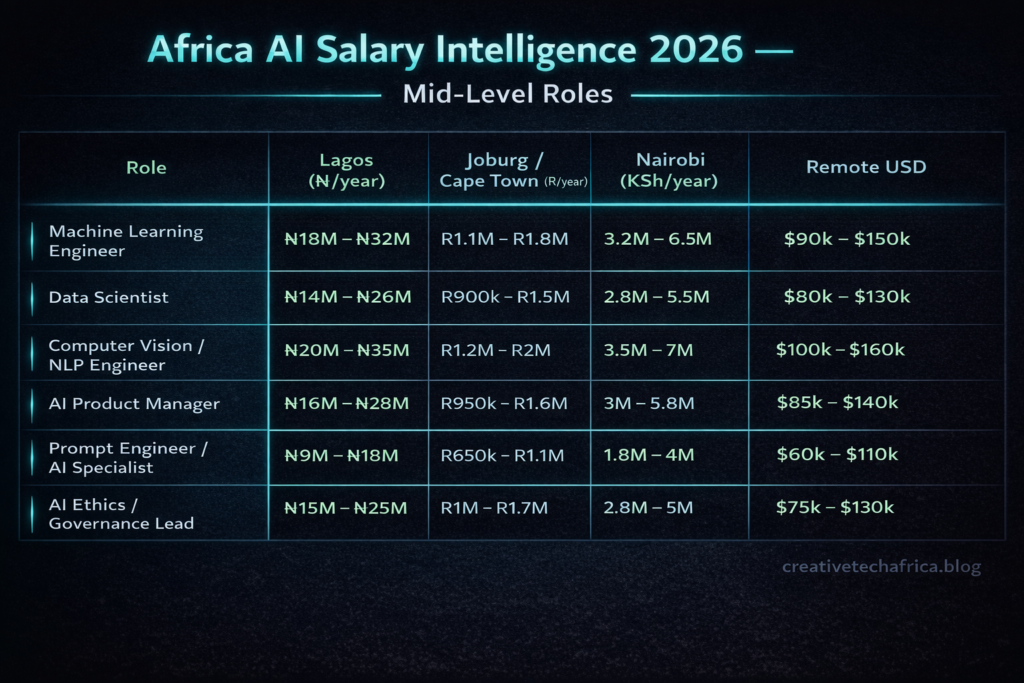
| Role | Lagos (₦/year) | Joburg/Cape Town (R/year) | Nairobi (KSh/year) | Remote USD |
|---|---|---|---|---|
| Machine Learning Engineer | ₦18M – ₦32M | R1.1M – R1.8M | 3.2M – 6.5M | $90k – $150k |
| Data Scientist | ₦14M – ₦26M | R900k – R1.5M | 2.8M – 5.5M | $80k – $130k |
| Computer Vision / NLP Engineer | ₦20M – ₦35M | R1.2M – R2M | 3.5M – 7M | $100k – $160k |
| AI Product Manager | ₦16M – ₦28M | R950k – R1.6M | 3M – 5.8M | $85k – $140k |
| Prompt Engineer / AI Specialist | ₦9M – ₦18M | R650k – R1.1M | 1.8M – 4M | $60k – $110k |
| AI Ethics / Governance Lead | ₦15M – ₦25M | R1M – R1.7M | 2.8M – 5M | $75k – $130k |
“AI talent in Africa is now the most undervalued asset on the planet. We pay senior engineers the same as Berlin startups — because we have to if we want to keep them.” — Chioma Okeke, Co-founder, Intron Health (Nigeria)
Builders vs. AI-Skilled Users: The Split That Determines Your Ceiling
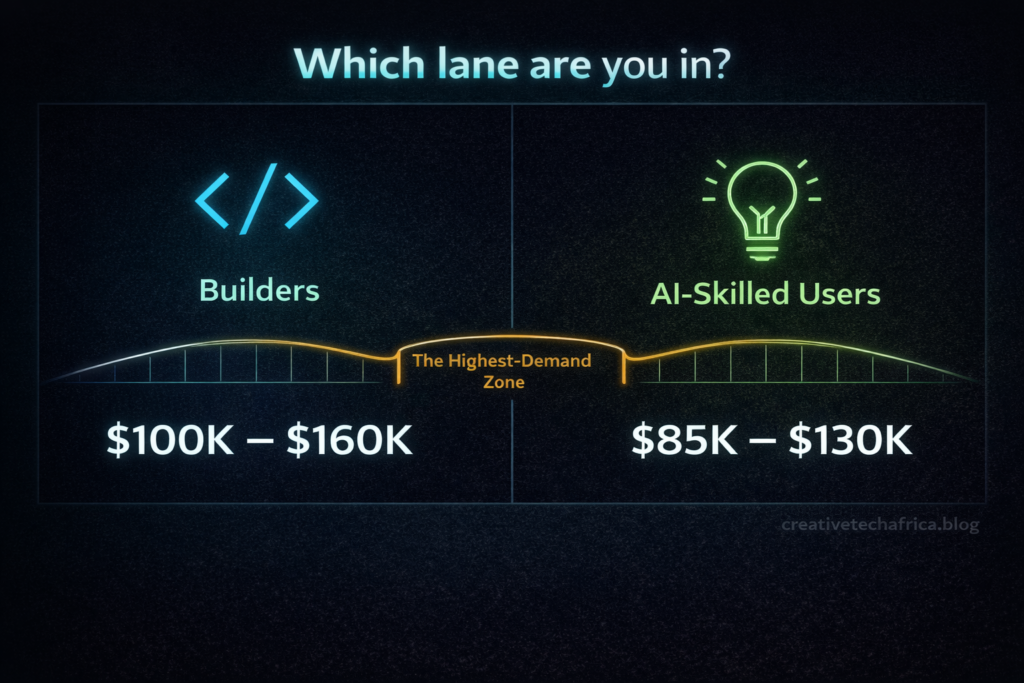
The AI job market in Africa has been divided into two segments. The segment you enter shapes your income potential, timeline, and the tools you need to get there.
Builders (code-heavy roles): Machine Learning Engineers, MLOps specialists, and Research Scientists command the highest salaries and represent the top of every table above. The barrier to entry is steeper, but so is the ceiling.
AI-Skilled Users (non-coding roles): Professionals using Claude, ChatGPT, Midjourney, and other tools at an expert level, marketers, lawyers, doctors, and designers are the fastest-growing and most accessible segment. Salary premiums of 20–40% over non-AI peers are now consistently documented across sectors.
The biggest 2026 opportunity sits in between.
Professionals who can translate business problems into deployable AI solutions, without writing production code, are becoming the most sought-after hires at African startups and multinationals. Think of it as the AI Product Manager layer: deeply strategic, commercially grounded, and highly paid. Our dedicated guide to becoming an AI Product Manager in Nigeria maps out the full path.
If you’re not yet sure which tool stack to build on, start with the best AI tools for Africans in 2026, which cover both builder and user-tier toolkits.
Remote USD vs. Local Currency: The Maths You Need to See
Here is the single most important financial comparison for any African professional considering an AI career.
A mid-level ML Engineer in Lagos earning ₦28M locally takes home roughly $18,000 USD per year at current exchange rates.
The same professional, placed through Andela at $9,000/month, earns $108,000 per year.
That is a 6x difference.
After accounting for Payoneer fees, a Starlink connection, inverter costs, and generator fuel, most remote-first professionals still clear 4–5 times their local take-home pay.
According to Andela’s 2025 talent survey, 71% of senior Nigerian AI developers now hold at least one active remote contract. The transition is already happening; the question is whether you’re part of it.
For a full breakdown of how to structure your remote income correctly, including platform choice and payment routing, see our guide to the best remote work platforms for Nigerian developers in 2026.
How to Earn Money With AI in Africa: The 8 Platforms That Actually Work
Which platforms are best for finding AI jobs in Africa? The most effective platforms for African AI professionals in 2026 are Andela (for $80k+ remote roles), Gebeya (strong in Kenya and Ethiopia), InTalent Africa (mid-level roles), and Turing or Toptal (for vetted USD contracts). Community-based channels, particularly WhatsApp and Slack groups, remain where many senior roles are filled first.
Not all platforms deliver equally for African talent. Here is where the hires are actually happening:
- Andela — still the gold standard for $80k+ remote engineering roles
- Gebeya — particularly strong for East African talent in Kenya and Ethiopia
- InTalent Africa — the most accessible entry point for mid-level professionals
- Turing & Toptal — competitive USD-remote roles with rigorous skills vetting
- Himalayas.app + WorkZly — growing indie remote platforms with less competition than the major boards
- LinkedIn with the Africa location filter active and “Open to Work” enabled
- Africa AI Jobs WhatsApp and Slack communities — where referral-based hiring actually happens
For a tactical breakdown of how to monetise AI skills across each of these channels, see our full guide on how to use AI tools to earn money in Africa in 2026.
And if you are based in Lagos, it is worth noting that the Google Developers Space in Lagos has become one of the most active physical hubs for connecting with hiring managers and sourcing remote referrals, particularly for roles requiring Google Cloud or ML certifications.
The Real Challenges — No Romanticising
The opportunity is real. So are the obstacles. Here is what the data and community conversations flag consistently:
Infrastructure costs — a reliable remote work setup requires an inverter and Starlink, with setup costs running between ₦700,000 and ₦1,000,000. Non-negotiable if you are taking remote USD calls.
ATS bias — global applicant tracking systems continue to filter out African university names and institutions before a human ever sees the application.
Visa barriers — denials for international conferences, client visits, and training programs remain a persistent and frustrating pattern for African professionals.
Currency devaluation — local salary gains in Naira are routinely eroded by exchange rate movement. This is one of the strongest structural arguments for pursuing remote USD income.
The Japa effect — brain drain is now forcing local startups to offer USD-equivalent compensation to retain senior talent. Painful for companies, but a signal of leverage for the professionals who remain.
Understand these barriers clearly and plan around them — rather than being blindsided by them mid-career.
Your 90-Day Action Plan to Break Into AI Careers in Africa
This is not a motivational list. It is a sequenced six-step process based on what is working for African professionals entering AI careers right now.
Step 1 — Get certified. The Google Professional Machine Learning Engineer certification and the AWS ML Specialty are the most widely recognised credentials across Lagos, Nairobi, and Joburg. Free learning paths exist for both. For a full comparison of options, see our guide on the top AI certifications recognised in Africa in 2026.
Step 2 — Build a portfolio. Ship three projects on Kaggle and GitHub. At least one should have a live, accessible demo. Recruiters at Andela and Turing evaluate portfolio depth before they consider your CV.
Step 3 — Set up your profiles. Create accounts on Andela, Turing, and Gebeya. Optimise specifically for remote roles — not local listings. The positioning language is different, and it matters.
Step 4 — Join the right communities. Get into five active Africa AI WhatsApp or Slack groups. The majority of senior roles still circulate through referral networks before they are publicly posted. If you are looking for where AI professionals actually gather in Nigeria, our breakdown of AI WhatsApp business networks in Nigeria for 2026 identifies the communities worth joining.
Step 5 — Apply deliberately. Target 50 roles — 20 local, 30 remote. Volume with strategic targeting beats spray-and-pray every time.
Step 6 — Negotiate every offer. According to Levels.fyi Africa data, the average successful counteroffer adds 21% to the initial figure. On a ₦18M offer, that is ₦3.78M left on the table if you say yes without negotiating. Do not leave it there.
2026–2030: Where African AI Careers Are Headed
![Dark background upward-trending area chart. Neon green fill below the curve. X-axis: 2025 to 2030. Y-axis: GDP contribution in billions USD. Annotation labels on key inflection points. Text overlay: "AI's Contribution to African GDP — 2026–2030 Projection." Source credit: McKinsey / GSMA]](https://creativetechafrica.blog/wp-content/uploads/2025/12/ChatGPT-Image-Apr-15-2026-09_59_40-PM-1024x683.png)
The structural trends strongly favour African AI professionals who position themselves now.
According to projections from McKinsey and the GSMA, AI is expected to add $15.7–$22 billion to African GDP by 2030. The talent required to deliver that impact does not yet exist at the scale needed — which is precisely where the opportunity lives.
The four trends to watch:
African-language LLM roles are the highest-growth segment. Yoruba, Swahili, Zulu, and Afrikaans language model work is dramatically undersupplied relative to demand. Prompt Engineers and NLP specialists focused here have almost no competition.
New hubs are rising fast. Kigali, Accra, and Cairo are emerging alongside Lagos, Nairobi, and Cape Town as serious talent and investment centres. Geographic diversification of opportunity is accelerating.
AI Ethics and Governance roles will triple. As regulatory frameworks arrive across the continent, demand for professionals who understand both AI systems and policy will increase sharply. Early movers into this space — particularly at companies like those listed below — are already seeing it.
Tool-level specialisation is creating premium niches. Professionals who go deep on specific platforms are beginning to command significant premiums. For a current comparison of leading AI platforms and how they perform for African use cases, see our breakdown of v0 vs. Claude — price and logic comparison for Nigeria.
For a broader view of companies building Africa’s AI layer, our list of top AI startups in Africa to watch in 2026 covers the most active employers on the continent right now.
African AI Companies Actively Hiring in 2026
These organisations are building the continent’s AI infrastructure — and actively recruiting:
- InstaDeep (Tunisia / London) — Karim Beguir, with a focus on deep learning and reinforcement learning
- Lelapa AI (South Africa) — Pelonomi Moiloa, African-language models
- Intron Health (Nigeria) — Chioma Okeke, healthcare AI and voice technology
- Aerobotics (Cape Town) — James Paterson, precision agriculture AI
- Imoterai (Nigeria) — African-language model development
Each of these companies represents a different entry point depending on your skill set. For a fuller list with hiring details, see the top AI startups in Africa to watch in 2026.
Frequently Asked Questions
Which African country pays AI professionals the most in local currency? South Africa. Rand-denominated salaries at the senior level remain the highest in absolute local terms across the continent.
Which country offers the best combination of lifestyle and remote income? Nigeria. Remote USD access combined with a lower cost of living produces the strongest net take-home mathematics, which is why 71% of senior Nigerian AI developers now hold remote contracts.
Do I need a university degree to get an AI job? Not for most remote USD roles. Banks, telcos, and large corporates typically still require formal credentials, but Andela, Turing, and Toptal evaluate primarily on demonstrated skill.
What is the most recognised AI certification across Lagos, Nairobi, and Joburg? Google Professional Machine Learning Engineer, followed closely by AWS ML Specialty. Both are recognised consistently across all three markets.
Can I earn in US dollars from Nigeria or Kenya without relocating? Yes. Seventy-one percent of senior Nigerian AI professionals already do, through platforms like Andela, Deel, and Payoneer-linked contracts.
What is the fastest-growing AI role in Africa in 2026? African-language Prompt Engineer and NLP Specialist. Demand is sharply outpacing supply, creating significant salary leverage for professionals who specialise here.
What is the tax situation on remote USD income in Nigeria? If earnings are routed correctly to a domiciliary account, effective tax exposure is minimal — but proper declaration is important. Consult a qualified Nigerian tax professional for your specific structure.
Where can I find AI tools built specifically for African professionals? Our roundup of AI skills for non-coders in Africa and the best AI tools for Africans in 2025 covers the most useful options by use case and budget.
The Data Is Clear. The Path Is Defined. What Comes Next Is Yours.
The professionals benefiting most from Africa’s AI moment are not necessarily the most technically gifted. They are the ones who moved with intention, who got certified, built publicly, joined the right networks, and negotiated without apology.
Everything in this guide points to the same conclusion: the window is open, the tools are accessible, and the income gap between those with AI skills and those without is widening every quarter.
To help you move faster, we have put together the 2026 African AI Prompt Library, 62 proven prompts built specifically for African professionals. Use them to craft standout job applications, negotiate offers confidently, build a compelling GitHub portfolio, and run LinkedIn outreach that lands interviews in Lagos, Nairobi, Joburg, and beyond.
→ Download the Free African AI Prompt Library
Sources: Andela 2025 Talent Report · Briter Bridges African Startup Data · Partech Africa VC Report · Levels.fyi Africa · McKinsey / GSMA AI Africa Projections



1 comment
[…] Samuel, D. (2025). AI Careers in Africa: The 2026 Salary Guide for Nigeria, South Africa, and Kenya. Creative Tech Africa. Retrieved from https://creativetechafrica.blog/ai-careers-salary-africa-2026-nigeria-south-africa-kenya/ […]