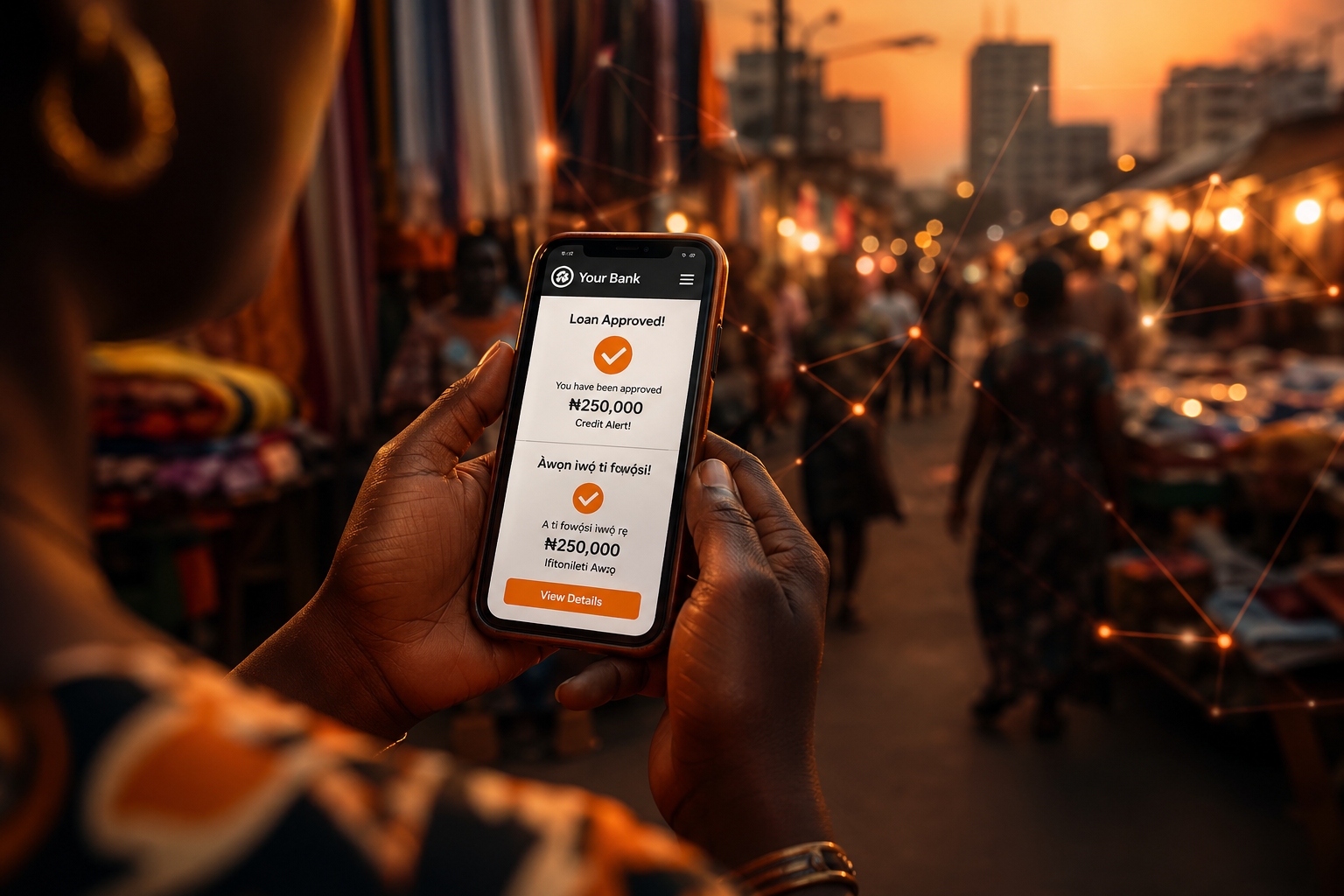
A market trader in Aba applies for a ₦200,000 working capital loan on her phone at 11 p.m. Zero physical offices. No co-signers. Nothing to fill out. Sixty seconds later, an AI model has checked 200+ data points from her mobile money history, airtime usage, and transaction patterns, and approved her loan. She’s got the funds before midnight.
This is AI fintech Africa, and it’s happening right now, at a scale most people outside the continent still underestimate.
While global tech media debates whether AI will replace bankers, Africa’s builders have already deployed it to serve the 350 million adults who never had a banker to begin with. You don’t need a credit history if you’ve got a smartphone and a mobile money account. That’s the shift this guide explains.
Here’s what you’ll find in this article:
In this guide
- What is AI fintech, and why does Africa lead?
- The 5 AI fintech use cases reshaping Africa
- Country breakdown: where it’s growing fastest
- African AI fintech startups to watch in 2026
- Challenges: what’s holding AI fintech back
- The regulatory landscape for builders
- What this means for African founders and builders
- Resources for going deeper
What is AI fintech, and why does Africa lead?
AI fintech means using machine learning, data analytics, and natural language processing to deliver financial services — credit, payments, insurance, identity, and savings.
The AI layer does what no human underwriter can: it processes thousands of data signals in real time to make fast, accurate decisions at scale.
Every major market is exploring this. But Africa’s specific conditions make it the most important AI fintech market on earth. Here’s why:
- It’s mobile-first, not bank-first. Africa has over 615 million unique mobile subscribers. Most people adopted digital wallets before they ever held a debit card. The data infrastructure for AI-powered finance was already built into daily life.
- 350 million+ adults are unbanked. Not by choice, formal banking was never designed for them. Informal income, thin credit files, and distance from bank branches created a gap that traditional finance can’t close. AI credit scoring closes it.
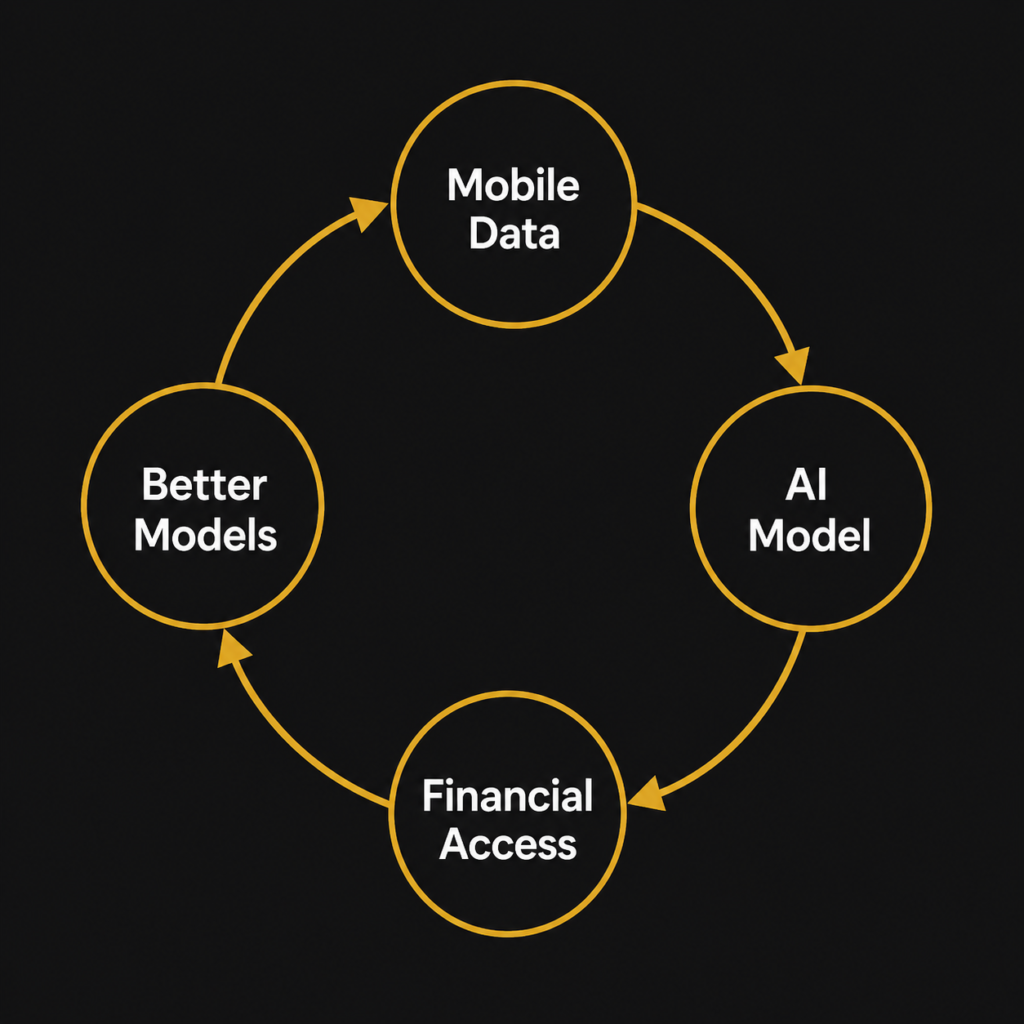
- The data is messy, fragmented, and enormous. Africa’s informal economy generates huge amounts of behavioral data, mobile money transfers, airtime purchases, utility payments, and marketplace activity. AI models trained on this data can outperform credit bureaus for people who’ve never owned a credit card.
The IFC says AI could add $1.3 trillion to Africa’s economy by 2030. McKinsey estimates a 30% productivity boost in African financial services over the next decade. Africa’s fintech revenue is projected to grow 13× to $65 billion by 2030.
The macro numbers are impressive. The more important story is what’s happening at the transaction level — for the trader in Aba, the boda boda driver in Nairobi, the fashion designer in Accra.
For a wider look at AI across the continent, read our full overview: The Complete Guide to AI in Africa →
Key takeaway
Africa’s mobile-first infrastructure, large unbanked population, and rich alternative data make it the world’s most fertile ground for AI-powered financial services. This isn’t a development story; it’s a market reality.
Free Guide · Awareness Stage
New to AI fintech? Start here.
Download our free one-page overview of AI’s role in Africa’s financial services — perfect for sharing with your team.
The five use cases driving this shift each have a distinct African signature, and each one is moving real money right now.
The 5 AI fintech use cases reshaping Africa
01 AI credit scoring
Traditional credit bureaus need formal employment records and loan history. Most African adults don’t have those. AI credit scoring reads the data that exists: mobile money velocity, airtime recharge patterns, digital commerce activity, and even the time of day when someone makes transactions.
Who’s doing it: Periculum processes behavioral telemetry to score thin-file borrowers. Lendsqr gives any fintech a plug-in AI credit decisioning engine. Branch International runs ML models trained on real repayment data across Nigeria, Kenya, and Tanzania.
DevelopmentAid estimates $330 billion in untapped credit demand across the continent. AI credit scoring is the key that unlocks it.
02 Fraud detection
Digital payments scaled fast. Fraud followed. Nigeria alone processes tens of millions of digital transactions daily, and the fraud vectors are sophisticated: SIM swaps, synthetic identities, account takeovers. Rule-based detection can’t keep up. Machine learning models trained on millions of flagged transactions can catch anomalies in real time.
Who’s doing it: The CBN Fintech Report 2025 found that 87.5% of Nigerian fintechs now use AI primarily for fraud detection, which is the most widely deployed AI application in the sector. OPay runs AI fraud detection as core infrastructure across hundreds of millions of monthly transactions.
03 Payments and remittances
Remittances to sub-Saharan Africa exceed $50 billion annually, but the sending-to-receiving corridor has historically been expensive (6–8% fees) and slow. AI solves both problems: dynamic FX pricing cuts spread costs, and predictive routing picks the fastest, cheapest payment rail in real time.
Who’s doing it: Taptap Send uses ML-powered routing to optimise corridors into Nigeria, Ghana, Senegal, and beyond. MNT-Halan in Egypt deploys AI across payments, microfinance, and e-commerce to serve 4 million+ customers in the informal economy. GSMA confirms $1.4 trillion flowed through mobile money in sub-Saharan Africa in 2025, and the AI layer securing these flows isn’t optional.
04 WhatsApp-based AI customer support
Africa’s preferred interface isn’t a polished app. It’s WhatsApp. With over 100 million users in Nigeria alone, fintechs are meeting customers there, with AI agents that handle loan applications, balance queries, fraud alerts, and support tickets around the clock.
A WhatsApp AI agent runs 24/7, handles Yoruba, Hausa, Swahili, and Pidgin, and costs a fraction of a human support team. That’s not a nice-to-have; it’s a unit economics decision.
Read our deep-dive: How Nigerian businesses are using AI on WhatsApp →
05 KYC and identity verification
Traditional KYC means document collection, manual review, and human sign-off, a process that can take days. AI-powered KYC compresses it to seconds: computer vision reads and validates ID documents, liveness detection confirms the applicant is real, and name-matching flags sanctions-list hits instantly.
The African challenge: IDs aren’t standardised. A Nigerian NIN looks nothing like a Kenyan Huduma Number or a South African green barcoded ID. Startups like Smile Identity and Youverify have built models that handle this variation — and they’re processing millions of verifications a month.
Key takeaway
Africa’s five core AI fintech use cases aren’t copies of Western models. They’re built for mobile-first, informal-economy contexts that Western financial AI was never trained on.
Free Checklist · Consideration Stage
Which AI fintech use case fits your product?
Use our 5-question checklist to figure out where AI creates the most value in your fintech, before you start building.
Each use case lands differently depending on which country you’re building in; the opportunities vary more than most people expect.
Country breakdown: where AI fintech is growing fastest
| Country | AI Fintech Maturity | Primary Use Case | Key Regulator |
|---|---|---|---|
| Nigeria | Very High | Fraud detection, credit | CBN |
| Kenya | Very High | Mobile credit, payments | CBK |
| Egypt | Growing | Microfinance, e-commerce | CBE / FRA |
| Ghana | Growing | Mobile money, KYC | Bank of Ghana |
| South Africa | High | Open banking, lending | FSCA / SARB |
West Africa
Nigeria
Nigeria is the continent’s largest fintech market by transaction volume, investment, and number of active platforms. The CBN’s fintech sandbox gives AI-powered products a formal path to market. Lagos has the engineering talent and product culture to match. OPay, Periculum, Lendsqr, and PiggyVest have collectively served tens of millions of users.
The real constraint isn’t product quality, it’s infrastructure. Power instability, data cost, and device fragmentation mean you have to design for low-bandwidth and intermittent connectivity from day one. Teams that do this well gain a structural edge. See how the broader ecosystem is evolving: 2026 blueprint for tech innovation in Nigeria → and Nigerian startups using AI tools in 2026 →
East Africa
Kenya
Kenya’s fintech story starts with M-Pesa, but the AI chapter is something different. High smartphone penetration, mature mobile money rails, and a deep developer community make it a natural home for experimentation. M-KOPA uses machine learning to underwrite asset financing for customers with no formal credit history. Branch International has been refining its credit AI on Kenyan data for nearly a decade.
The Central Bank of Kenya’s engagement with digital lenders through its sandbox framework gives builders a clearer regulatory path than most African markets. Nairobi’s talent pipeline, from the University of Nairobi, Strathmore’s iLab, and a growing startup ecosystem, keeps the engineering supply strong.
North Africa
Egypt
Egypt is the continent’s most underrated AI fintech story. 106 million people, a huge informal economy, and a government that’s actively pushed financial digitisation. MNT-Halan is the standout, a platform that uses AI to serve merchants, consumers, and micro-enterprises with credit, payments, and e-commerce in one stack. It’s reached millions of customers by building for Egypt’s specific economic context.
Egypt’s also ahead on Arabic-language AI. With NLP models trained specifically on Egyptian Arabic dialects, the conversational layer of fintech chatbots and voice assistants works better here than in most African markets. The CBE’s updated fintech regulation now explicitly covers algorithmic lending and digital KYC.
West Africa
Ghana
Ghana punches above its weight in fintech. Mobile money penetration is among the highest on the continent, MTN Mobile Money and Vodafone Cash dominate, and the Bank of Ghana has been progressive. AI fintech here clusters around mobile money optimisation, KYC for unbanked customers, and insurance tech. Several Nigerian fintechs have used Ghana as their first expansion step, finding enough similarity in the mobile-first culture to port models with limited recalibration.
The unique challenge: currency volatility. The cedi has depreciated significantly in recent cycles, which breaks AI models trained on historical transaction data. Builders who solve for inflation-adjusted training and multi-currency architecture build something genuinely defensible.
Southern Africa
South Africa
South Africa’s financial sector is the most sophisticated on the continent, which makes its AI fintech story different from the rest. The opportunity isn’t financial inclusion from scratch; it’s modernising established institutions. Capitec, FirstRand, and Standard Bank all run serious AI programmes. The FSCA’s open banking push creates API infrastructure that lets AI-powered fintechs build on top of existing rails. The FSCA’s Innovation Hub offers structured engagement for startups testing novel AI models, the clearest regulatory pathway on the continent.
The complexity: South Africa’s inequality means you’re simultaneously building for a sophisticated urban middle class and a rural, cash-dependent population with completely different data profiles. Teams that solve for both find a more defensible position than those who optimise for just one.
Which market are you building for?
- 🇳🇬 Nigeria
- 🇰🇪 Kenya
- 🇿🇦 South Africa
- 🇪🇬 Egypt
- 🇬🇭 Ghana
- 🌍 Multiple markets
Click your answer, or replace this poll with a Typeform or Tally embed for real response data.
Key takeaway
Nigeria and Kenya lead on volume. Egypt’s the fastest-growing story that few people outside the continent are watching. Ghana’s a smart expansion node. South Africa is where AI meets established financial infrastructure. Each market needs a distinct product approach; you can’t just port a model and change the currency.
Across all five markets, a set of startups is doing the actual building, and their decisions are shaping the next decade of African financial services.
African AI fintech startups to watch in 2026
These aren’t companies in accelerator pitches. They’re live, scaled products with real users, real revenue, and AI systems running in production.
OPay: Nigeria
Started as a payments super-app, now a full financial services platform. OPay runs AI fraud detection as core infrastructure — not an add-on. It processes hundreds of millions of transactions monthly and flags anomalies in real time without slowing legitimate payments. Hundreds of millions of monthly transactions
PiggyVest: Nigeria
Nigeria’s leading savings and investment platform. AI powers its savings-nudge engine, investment-recommendation layer, and fraud monitoring. By reading individual saving behavior, it surfaces personalised reminders that’ve measurably improved how consistently users save. 5M+ registered users
Periculum: Nigeria
One of Africa’s most technically sophisticated alternative credit scoring companies. Periculum processes mobile telemetry, transaction history, and behavioral signals to score borrowers with no formal credit file, and offers the API layer so other lenders can plug in directly. B2B credit intelligence across the continent
Lendsqr: Nigeria
Lendsqr is building lending infrastructure, the equivalent of Stripe, but for African credit. Any lender can deploy a fully AI-powered loan product using Lendsqr’s decisioning engine and portfolio analytics, without building from scratch. It’s accelerating AI adoption across the whole sector. 100+ lenders on the platform
Branch International: Kenya · Nigeria · Tanzania
Branch has been running ML credit models in Africa since 2015, longer than almost anyone else. Its models have been trained on hundreds of millions of repayment data points across three markets. That’s one of the richest AI credit datasets on the continent. 40M+ loans disbursed
M-KOPA: Kenya · East Africa
M-KOPA finances smartphones and solar systems using pay-as-you-go credit powered by machine learning. The AI model assesses creditworthiness from mobile money behavior and adjusts repayment terms dynamically. Most customers have no formal bank accounts. 3M+ customers financed
MNT-Halan: Egypt
Egypt’s leading embedded finance platform. Serves merchants and consumers in the informal economy with AI-powered credit, payments, and e-commerce in a single app. The AI layer handles credit decisions, dynamic pricing, and fraud detection simultaneously across all product lines. 4M+ customers served
Taptap Send: Pan-African / Diaspora
Uses ML-powered routing to optimise remittance corridors into Nigeria, Senegal, Ghana, and beyond. By dynamically selecting the cheapest, fastest payment rail per transaction, it delivers real cost savings to diaspora senders and keeps more money in recipients’ hands. 10+ African corridors served
For a deeper look at Nigerian AI startups specifically, see: Nigerian startups using AI tools in 2026 →
Key takeaway
The best African AI fintech startups aren’t demos. They’re deploying AI in production, at scale, in complex environments, for users who depend on these products for real financial outcomes. That’s the benchmark.
Challenges: what’s holding AI fintech back in Africa
These are real obstacles. They’re also exactly why companies that solve them build defensible competitive moats.
- Infrastructure gaps: Nigeria’s power grid delivers fewer than 12 hours of electricity per day in many cities. Data centre reliability, device battery life, and network latency aren’t software problems; they’re physical constraints. Your AI system has to be designed around them from the start, not patched afterward.
- Data poverty and bias risk: Training data in most African markets skews toward urban, formally employed, and male. Models trained on this data will systematically underserve rural women, informal traders, and recent migrants. That’s not just an ethics problem; it’s a product quality problem. If your model can’t score the people you’re supposed to serve, your TAM is smaller than you think.
- Digital literacy gaps: AI-powered products only work if customers can use them. In markets where many users are first-generation smartphone owners, UX is as important as the model underneath. Voice interfaces, local language support, and USSD fallbacks aren’t optional.
- Fragmented regulation: There’s no single African framework for AI in financial services. Each country has its own central bank, its own fintech licensing rules, and its own evolving position on algorithmic credit and data use. Operating across three markets means three compliance stacks. Plan for that cost from the start.
- Currency instability: When a currency depreciates 30% in a year — as the naira, cedi, and Egyptian pound have all done in recent cycles, AI models trained on historical local-currency data can drift badly. You need ongoing model monitoring and recalibration. Most teams aren’t resourced to do this consistently.
For broader context on AI policy and what it means for Africa’s builders, see: OpenAI and the Africa AI policy question →
Key takeaway
Every constraint listed above is a product problem that, when solved, becomes a competitive advantage. The teams that treat them as design constraints, not excuses, are the ones building things worth building.
Understanding the obstacles is step one. Knowing the specific regulatory terrain for your market is what separates teams that scale from teams that stall at compliance.
The regulatory landscape: what builders need to know
Regulatory environments across Africa’s five major AI fintech markets are moving toward clarity — slowly, and unevenly. Here’s what matters right now.
Nigeria — CBN Fintech Sandbox
The CBN’s sandbox lets qualifying companies test AI-powered financial products in a controlled environment for a set period. It’s the fastest legitimate route to market for novel AI fintech products in Nigeria. The CBN’s 2025 Fintech Report explicitly named AI as a priority focus area, and regulatory scrutiny of AI systems will increase. Build for auditability from day one, not as an afterthought.
Kenya — Central Bank of Kenya Framework
The CBK’s Digital Credit Providers Regulations (2022) created a formal licensing structure for digital lenders, many of whom use AI for credit decisions. If you’re running a credit product in Kenya, you need a DCP licence, and your AI model’s decisions need to be explainable on request. The CBK has been one of the more forward-thinking central banks in Africa on this, which makes Kenya a good market for careful regulatory co-creation.
South Africa — FSCA Innovation Hub
The FSCA’s Innovation Hub is the most structured engagement mechanism for AI fintech on the continent. It offers dedicated guidance for startups testing novel products, with a clearer path to full licensing than most other markets. Also, South Africa’s Protection of Personal Information Act (POPIA) is one of Africa’s most comprehensive data protection laws. Understand its implications for how you train models on customer data before you write production code.
Egypt — CBE and FRA
The Central Bank of Egypt’s Fintech and Innovation Strategy and the Financial Regulatory Authority’s oversight of non-bank financial services have created a workable framework for AI-powered lending. MNT-Halan has engaged directly with the CBE in shaping the rules it operates within. That kind of regulatory co-creation takes time, but it’s a strategic advantage if you can achieve it.
Key takeaway
The regulatory question isn’t “how do I avoid regulators?”, it’s “how do I build for compliance by design?” Explainability, data governance, and audit trails belong in your architecture before your first user, not bolted on before your first examination.
Want to understand the talent and compliance roles this landscape is creating? See our guide: AI careers and salaries in Africa in 2026 →
All of this market context leads to the question that actually matters for most people reading this: what do you do with it?
What this means for African founders and builders
This section is for you, not for a Western investor reading over your shoulder. Here are five things worth acting on.
1. Start with the data problem, not the model
The best AI fintech products in Africa succeed because their teams understood the data landscape before they touched a model. Spend your first month auditing what data you can legally access, what it actually reflects, and where the gaps are. Your competitors are using the same off-the-shelf models. Your edge is data quality and local knowledge, not algorithm sophistication.
2. Build for low-bandwidth first
Your AI product should work on a 3G connection in Ibadan, not just on Lagos Island fibre. Model compression, edge inference, USSD fallbacks, and WhatsApp interfaces aren’t accessibility features; they’re market reach decisions. A product that breaks when the network degrades has a much smaller addressable market than it thinks it does.
3. Pick your compliance posture early
Companies that build for explainability from day one, keeping logs of model decisions, maintaining human escalation paths, and separating training data from production data, spend less on remediation when regulators come asking. It’s also a B2B sales advantage. A bank will choose the AI credit partner whose model they can explain to their own risk committee.
4. Localise the model, not just the interface
Porting a Nigerian credit model to Kenya and changing the currency isn’t localisation, it’s copying. Repayment behaviour, loan purpose distributions, mobile money patterns, and seasonal income variation differ meaningfully between markets. Retrain on local data. The effort is real. The accuracy improvement justifies it.
5. The B2B2C infrastructure layer is underbuilt
Lendsqr built infrastructure for lenders. Periculum built credit intelligence as an API. The market for AI fintech infrastructure, the layer that lets other fintechs deploy AI without building it themselves, is less crowded than the consumer-facing layer and more defensible. If you’re a developer reading this, the tools other African fintech builders need are exactly the kind of product you’re positioned to build.
Key takeaway
Your competitive advantage in African AI fintech isn’t access to better models. It’s access to better data, deeper local knowledge, and distribution that no outside team can replicate. Build from that position.
For the practical economics of using AI tools as a builder in Africa: How to use AI tools to earn money in Africa in 2026 →
Evaluating which development tools to invest in? Read our honest breakdown: v0 vs Claude — price and logic comparison for Nigerian builders →

Free Template · Decision Stage
Ready to build? Use our AI fintech product scoping template.
A 1-page document to define your use case, data sources, compliance requirements, and market before you write a line of code.
If you want to go deeper than this article covers, here’s exactly where to go.
Resources for going deeper on AI fintech in Africa
- The Complete Guide to AI in Africa — The full overview of AI across the continent’s tech economy: education, finance, creative industries, and more.
- Nigerian Startups Using AI Tools in 2026 — Startup-by-startup breakdown of how Nigerian companies are deploying AI in production, with real product context.
- Best AI Tools for Africans — A practical guide to the AI tools ecosystem that’s actually available and affordable for African builders and creators.
- Perplexity AI for African Tech Innovators — How real-time AI search is changing research and competitive intelligence for Africa’s builders.
- AI in African Classrooms — The pipeline that’ll supply Africa’s next generation of AI builders — how AI literacy is developing from the ground up.
- IFC Africa AI Report (External) — The International Finance Corporation’s analysis of AI’s economic potential across African financial services. Essential for the macro picture.
The bottom line
AI fintech in Africa isn’t a trend on a slide deck at a London conference. It’s live, at scale, moving real money for real people across Nigeria, Kenya, Egypt, Ghana, and South Africa, and the companies building it aren’t waiting for a more favorable environment to appear.
The $330 billion credit gap won’t close unless someone builds the products to close it. The $1.4 trillion flowing through mobile money won’t secure itself; it needs AI fraud detection running every hour of every day. The 350 million unbanked adults won’t get financial access through goodwill; they’ll get it through AI credit models that can score them accurately without a credit bureau file.
Africa’s AI fintech moment isn’t coming. It’s here. The only question is how fast you move and how well you build.
Go deeper on AI in Africa
This article is part of our complete guide to artificial intelligence across the African tech and creative economy.
Explore the full AI in Africa guide →AI for African Creators • AI & Fashion in Nigeria