Tin City Founders Jos has run three mixers since July 2026, growing from 30 to 41 registered guests — a 37% increase across three events, averaging 35 a month. In a country where the startup conversation usually starts and ends in Lagos, that quiet climb matters. This is what’s actually happening inside the room: who’s showing up, what they’re trading with each other, and why a monthly Friday evening in Jos, Plateau State, is turning into one of the most talked-about founder gatherings outside the big two cities.
This is the second piece in our Tin City Founders series — read the first, on the night Jos stopped building alone, for how it all started.
What Is Tin City Founders?
Tin City Founders is a not-for-profit association advancing entrepreneurship, innovation, and economic development among founders and small business owners in Jos, Plateau State, Nigeria. Established in 2026, it applies whatever income it generates solely to community objectives — it is not an investor, an accelerator, or a competition, and it does not fund, invest in, or select the founders who attend. The organisation describes itself as Jos’ trusted room for builders to share practical insight, open doors, and turn mutual support into durable enterprise, and its tagline sums up the whole philosophy in one line: “No founder should build alone. Give before you take.” In practice, that shows up as monthly networking mixers, mentorship programmes, skills-development initiatives, and community-development projects — all built around founders helping each other first and asking second.
Setting the Stage
For years, Nigeria’s startup conversation has centred almost entirely on Lagos, with Abuja a distant second. Founders building outside those two cities — in Jos, Kaduna, Ilorin, and dozens of other regional hubs — have had few structured spaces to meet each other, compare notes, or simply confirm they’re not building alone. Tin City Founders exists to close that gap specifically in Jos.
It isn’t trying to be an accelerator or an investor, and it isn’t running a pitch competition. Nobody walks away from a mixer with a term sheet. What they walk away with is closer to a functioning room: a recurring, low-friction gathering where the only real entry requirement is a willingness to give something before asking for anything. That not-for-profit framing — income applied solely to community objectives, nothing extracted from the founders who show up — is what keeps the mixer feeling like a community rather than a sales floor.
That gap isn’t abstract, either. Founders in Jos have spent years defaulting to Lagos-based WhatsApp groups, X threads, and the occasional flight south just to find people solving similar problems. A structured, local, recurring room changes that calculus — you don’t need a plane ticket to find a co-founder, a first customer, or the person who already solved the problem you’re stuck on.
Founder Spotlight: Who’s in the Room
The mixer draws a wider mix than any single write-up can capture — logistics founders, cybersecurity specialists, student developers, documentary filmmakers, and everything in between. Two of the regulars give a useful cross-section of who’s actually in the room.
John Paul Tahiru — CyberShield Technologies

John Paul Tahiru is a cybersecurity expert and ethical hacker building CyberShield Technologies. In a room that skews heavily toward software and product builders, he’s often the security specialist in attendance — there less to chase a specific problem than for the straightforward value of being around other founders on a regular basis.
Ezekiel Geoffrey Izam (“Geoflex”) — Geoflex Tech World
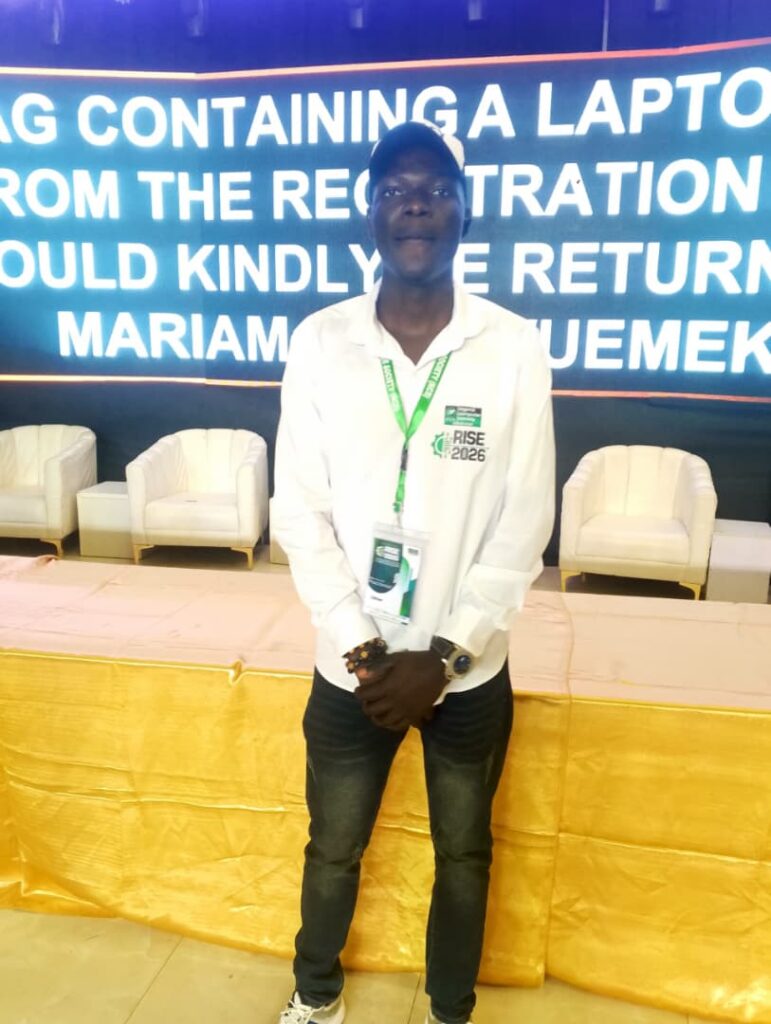
Ezekiel Geoffrey Izam — known in the room as “Geoflex” — is building Geoflex Tech World alongside a handful of student-tech, community-platform, and software projects. His challenge is one a lot of early-stage builders will recognise: turning ideas into sustainable products with real users. He’s showing up specifically for connections and collaboration — the kind of introduction that rarely happens cold, but happens naturally over three hours in a room built for exactly that.
What Actually Happens at a Mixer
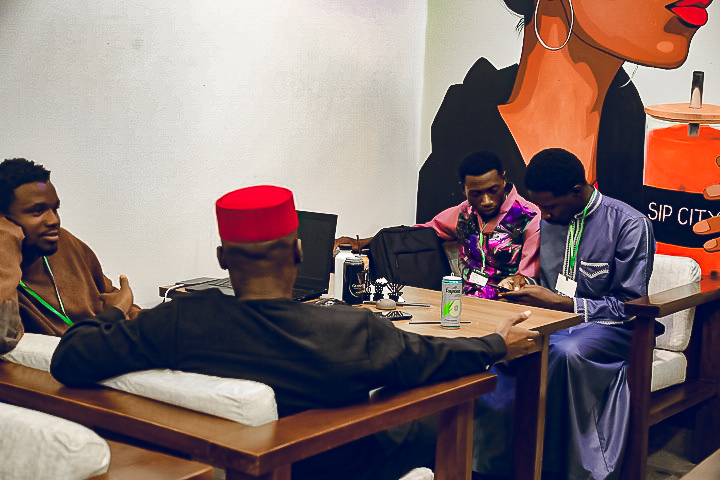
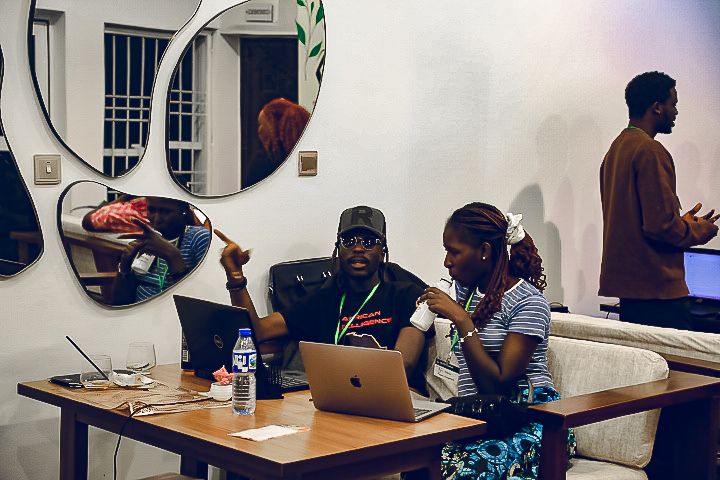
Walk into any Tin City Founders mixer and the first thing you notice is what’s missing: no stage, no slide deck, no queue of people waiting to pitch. What’s there instead is a room of Plateau State’s own — Jos-based developers, agency owners, service providers, and first-time founders — talking, trading favours, and quietly building the kind of trust that never shows up on an event platform’s registration count.
The signature mechanic — and the strongest reason to attend rather than just follow along from the sidelines — is the give-and-ask board.
Every attendee gets a sticky note and writes two things on it: something they can give another founder for free, and something they need. The give goes first, deliberately — a small piece of design that stops the board from turning into a wall of wishlists. Notes go up on a board the whole room can read, and once the mixer wraps, the board gets photographed and shared in the WhatsApp group so anyone who missed that Friday can still claim what’s on offer.
Recent boards give a real sense of the range on both sides. On the giving side, founders have offered a free cybersecurity audit and vulnerability check for a web app, a free scan to make a business more visible to AI assistants and Google, a free portrait session from a working photographer, and an open door to a funded programme the giver had already been through themselves. On the asking side: a 2TB SSD to store HD footage for a documentary in production, and strategic connections, partnerships, and customers for a logistics and on-demand delivery venture.
Beyond the board, past recaps mention name tags, a “Pass the Mic” segment, and a “Speed-Founding” round — worth confirming with the organisers that these are still part of the current lineup before assuming they’ll happen at the next one. What has stayed consistent across all four mixers so far is the shape of the evening itself: roughly three hours, always starting at 5pm, always on the first Friday of the month. And two things the format deliberately leaves out: there’s no headline sponsor dominating the room, and no panel of outside speakers talking at everyone. It’s peer-to-peer, by design.
Why Jos and Not Lagos
It’s a fair question: why build a founder community in Jos when Lagos has the infrastructure, the investors, and the noise?
Part of the answer is cost. Jos is dramatically cheaper to live and build in than Lagos or even Abuja, which matters enormously for anyone bootstrapping without outside funding. Part of it is the pipeline: the University of Jos sits right in the middle of the city, feeding a steady stream of technically capable graduates into a local scene that, until recently, had nowhere obvious for them to land. That pipeline effect compounds — every graduate who stays in Jos rather than relocating south is a potential mixer attendee, WhatsApp member, or Built In Jos directory listing, and every mixer that runs makes staying in Jos look a little more viable than it did the month before. And part of it is heritage — Jos carries the “Tin City” name from its tin-mining history, a reminder that this has always been a place people came to extract value and build industry, long before “tech hub” was a category anyone used.
None of this is happening in isolation. Plateau State’s tech scene has been building toward this moment for a while — through gatherings like HackJos and Jos Tech Fest, through platforms like Decentra by RexC4 exploring what Web3 looks like in Plateau, and through the wider push to spotlight the region’s builders and creators. Read more on how Jos became Nigeria’s secret AI hub. Tin City Founders reads less like a brand-new phenomenon and more like the next layer on top of work that was already underway.
How to Join
The next mixer already has a date, a venue, and a theme.
Tin City Founders’ fourth mixer lands on Friday, 2 October 2026, 5–8pm, back at Nirvana Park & Gardens — the same venue as September. It’s themed “Independence Edition,” landing the day after Nigeria’s 66th Independence Day, with flyer copy reading “Nigeria at 66” and “Jos Builds Bigger.” As with every mixer so far, it’s free to attend — no funding, no CAC registration, and no finished product required. You just need to show up ready to give before you ask.
If a single evening feels like a big first step, there are two lower-commitment ways in. The WhatsApp community now runs over 100 founders — a live, ongoing thread for the kind of casual “does anyone know a…?” questions that don’t need a mixer to answer. And if neither of those feels right yet, the Built In Jos directory is the lightest touch of all. As of 22 September 2026, it holds 77 founder submissions, 63 of which are publicly listed after consent and deduplication — representing 62 ventures across 8 sectors and 4 locations across Plateau State. That’s a directory figure, not a mixer headcount and not a WhatsApp membership number, but it’s still the fastest way to see who’s already building in Jos and get discovered yourself. A short form, linked from the Tin City Founders homepage, gets you added. You can also follow along on Instagram and TikTok.
Whichever door you walk through first, the philosophy stays the same: give before you take, and no founder builds alone.
Frequently Asked Questions
How do I join Tin City Founders?
Show up to the next mixer — Friday, 2 October 2026, at Nirvana Park & Gardens in Jos. It’s free and open to anyone building something, whether or not you’ve registered a company yet. You can also join the WhatsApp community, which now runs over 100 founders, or submit your venture to the Built In Jos directory as a lower-commitment way to connect between mixers.
Are there startup events in Jos, Plateau State?
Yes. Tin City Founders runs a mixer on the first Friday of most months in Jos, alongside other Plateau State tech gatherings like HackJos and Jos Tech Fest. Its focus is specifically founder-to-founder connection through its give-and-ask board format, rather than pitching or competition.
Does Tin City Founders fund or invest in startups?
No. It’s a not-for-profit association that convenes founders — it doesn’t fund, invest in, or select the businesses that attend. Its income is applied solely to running the community itself.
What happens at a Tin City Founders mixer?
The centerpiece is the give-and-ask board: every attendee writes down something they can give another founder for free and something they need, and the board is photographed and shared afterward so the wider community can follow up. Each mixer runs about three hours, starting at 5pm, with no sponsor and no outside speakers dominating the room.