
Introduction: Most Africans Know About AI. Very Few Are Earning From It.
Here is the uncomfortable truth: AI awareness is not the problem in Africa. Execution is.
Millions of young Nigerians, Kenyans, Ghanaians, and South Africans have heard about ChatGPT, Claude, and Midjourney. Many have played with the tools. But very few have landed a single paid gig using them.
The gap is not intelligence. It is not access to capital. It is not even infrastructure.
The gap is a clear, specific answer to one question: Which skill should I learn, how do I get my first client, and how do I get paid?
This guide answers that question directly.
You will get five AI skills with honest earning ranges, the platforms where Africans are actually getting hired, a country-by-country payment guide, and a 30-day plan to land your first gig.
No theory. No hype. Just a clear path from AI-curious to AI-paid.
Who this is for: Freelancers, side-hustlers, recent graduates, and career-switchers in Nigeria, Kenya, Ghana, and South Africa who want to build income using AI tools in 2026.
Why AI Is a Real Income Path for Africans Right Now
Africa’s digital labor market is growing faster than most people realize.
According to World Bank and IFC projections, Africa’s freelance and digital economy is on track for significant expansion through 2030, driven partly by rising global demand for remote talent. Upwork’s 2025 Global Freelance Hiring Report documented a sharp rise in job postings targeting Sub-Saharan African workers on international platforms. To understand the full picture of Africa’s growing AI economy, including policy trends, infrastructure investment, and sector-specific adoption, the broader landscape matters as much as the individual income paths covered here. (Note: Exact figures from these reports should be verified against the primary sources before citing publicly.)
What makes 2026 different from previous years is AI.
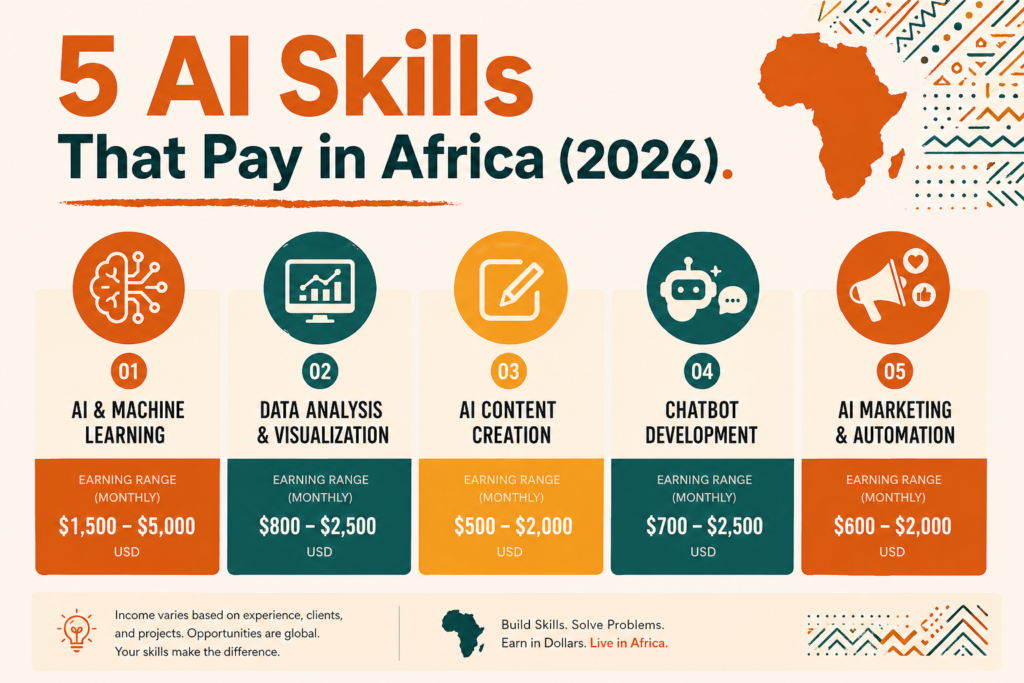
Freelancers who actively use AI tools are completing work faster and commanding higher rates than those who do not. The productivity gap is real and growing. A content writer who can deliver three polished articles in the time it used to take to write one does not charge the same rate as someone working without AI assistance. They charge more, and clients pay it.
Africa’s AI market itself is projected to grow from approximately $4.5 billion in 2025 to over $16 billion by 2030, according to McKinsey Africa research. That growth creates demand for people who can operate, train, and apply AI tools, not just consume them.
The opportunity is specific. It rewards people who learn one skill deeply and execute consistently.
The 5 AI Skills That Pay in Africa (2026)
Each skill below is listed with what it is, who it is for, the tools you need, how to start for free, realistic earnings, the most common mistake beginners make, and one practical example.
Start with one skill. Master it. Then expand.
Skill 1: Prompt Engineering
What it is: Prompt engineering means writing structured instructions that make AI tools produce consistent, useful, on-brand outputs at scale. It is the skill of knowing how to talk to AI so that the results are reliable enough for a real business to use.
Who it is for: Anyone with strong writing skills and the patience to test, iterate, and document what works. No coding required.
Tools needed:
- ChatGPT (free or Plus)
- Claude
- A simple document tool to organize and sell your prompt libraries
- For a broader view of AI tools built specifically for African users, including free options across different skill categories, see our full tools overview.
How to get started (free):
- AltSchool Africa offers free and subsidized AI courses, including prompt engineering pathways.
- She Code Africa runs fully funded programs for women in tech across Africa.
- YouTube has strong free tutorials, search “prompt engineering for beginners 2026.”
Realistic earnings: $35–$60 per hour for consulting or prompt audits. $50–$150 for a starter prompt package (5–10 specialized prompts for a specific niche like fintech or real estate).
Common mistake: Trying to sell generic prompts. Generic does not sell. Niche prompts for a specific industry, fintech onboarding emails, e-commerce product descriptions, legal document summaries, sell far better because clients see the direct value.
Practical example: Create five specialized prompts for a fintech company: one for customer onboarding emails, one for transaction alerts, one for support responses, one for product announcements, and one for social media captions. Package them for $75–$150 and pitch directly to Nigerian or Kenyan fintech startups who are already using AI but producing inconsistent content.
Skill 2: No-Code AI Automation
What it is: Using tools like Zapier, Make (formerly Integromat), and Bubble to connect apps and automate repetitive tasks — without writing a single line of code. You are essentially building the workflows that save small business owners hours every week.
Who it is for: Logical thinkers who enjoy systems, processes, and problem-solving. Good for people with a background in admin, operations, or customer service who want to move into tech.
Tools needed:
- Make (free plan available)
- Zapier (free plan available)
- ChatGPT or Claude (for building AI-powered workflow logic)
How to get started (free):
- Zapier University is free and structured.
- Make has a free course library on its website.
- Search YouTube for “Make + ChatGPT automation tutorial.”
Realistic earnings: $200–$500 for a single automation project. $500–$1,500 for a multi-step workflow system. Some specialists charge monthly retainers of $300–$800 to maintain and improve automations over time.
Common mistake: Learning three tools at once. A Kenyan developer documented his own experience with this mistake clearly: after months of being mediocre at Zapier, Make, and Bubble simultaneously, he focused exclusively on Make for 30 days and landed his first paid automation project in week five. Depth beats breadth, especially at the start.
Practical example: Pitch a local SME owner with this exact offer: “I will automate one task in your business, invoicing, lead follow-up, or social scheduling, and save you five hours per week. Fixed price: $200. If it does not work, I will refund you.” This low-risk framing makes it easy for small business owners to say yes.
If you want to understand the Nigerian business landscape you will be selling into, how local companies are already using and thinking about AI, read our breakdown of how Nigerian businesses are adopting AI tools right now. And if your prospect uses WhatsApp for customer communication (most Nigerian SMEs do), you can automate their WhatsApp business communication as a standalone service; it is one of the most in-demand automation offerings in the market.
Skill 3: AI-Assisted Content Writing and Copywriting
What it is: Using AI to handle research, outlines, and first drafts — while you bring the strategy, SEO structure, brand voice, and quality control. The model does roughly 70–80% of the drafting work. You do the thinking that makes it actually good.
Who it is for: Strong writers who want to multiply their output. People with experience in marketing, journalism, social media, or academic writing have a natural head start.
Tools needed:
- ChatGPT or Claude (drafting and research)
- Perplexity AI for faster research — particularly useful for finding current data points, verifying claims, and building article briefs faster than traditional search
- Grammarly (editing and clarity)
- Surfer SEO or Clearscope (optional — for SEO-optimized content)
- Google Docs
For African creators building income through video and multimedia content alongside writing, explore free AI tools for African creators, including animation and short-form video tools optimized for mobile-first workflows.
How to get started (free): Build a small portfolio. Pick three niches, for example, Nigerian fintech, East African health tech, and South African e-commerce, and write two sample articles per niche using AI assistance. Publish them on Medium or a free WordPress site. These samples are your proof of work.
Realistic earnings: Entry level: $15–$40 per hour, or $0.10–$0.20 per word. Intermediate (6–18 months): $40–$60 per hour, or $500–$1,000 per project once you can show traffic or conversion results. Experienced: $60–$100 per hour for conversion-focused copy with proven ROI.
Common mistake: Submitting raw AI output without editing. Clients can tell. Worse, search engines are getting better at detecting thin, unedited AI content. Your value is the judgment you apply to the output, not just the speed.
Practical example: A Lagos-based creator built a side income of approximately ₦420,000 per month (around $520) posting three videos per week on YouTube, scripted entirely with ChatGPT and edited on CapCut, all from a phone. His insight: “The algorithm rewards consistency over production quality.” The same logic applies to written content clients. Consistent, well-edited output beats occasional brilliant pieces.
Skill 4: AI Operations and Data Annotation
What it is: Human-in-the-loop work that supports AI systems. This includes reviewing flagged outputs, labeling training data, validating model responses for accuracy, and improving AI quality at scale. Think of it as quality control for artificial intelligence.
Who it is for: People who are detail-oriented, patient, and comfortable working with structured tasks. No technical background required for entry-level roles, though analytical skills help you move up faster.
Tools needed:
- A reliable internet connection
- Basic spreadsheet skills (Google Sheets or Excel)
- English proficiency (and African language skills are a major advantage — more on this below)
Where to find work:
- Scale AI (scaleai.com)
- Sama (sama.com) — specifically hires in Kenya and other African markets
- Labelbox (labelbox.com)
- Appen
Realistic earnings: Entry level: $1,000–$2,000 per month. After 12–18 months with consistent performance and expanded skills, approximately $2,500 per month. Specialized annotators with rare language skills earn more.
Common mistake: Treating annotation work as passive income, you can rush through. Quality scores matter. Low-quality scores reduce your access to higher-paying tasks and can result in removal from the platform.
Practical example: Sama specifically recruits in Kenya and has a documented history of hiring locally for AI data projects. If you are based in Nairobi or another major Kenyan city, Sama is worth a direct application. Check their careers page and apply with a clear, brief note explaining your language skills and attention to detail.
Skill 5: Multilingual NLP and African Language Data Work
What it is: Labeling, translating, recording, or validating AI training data in African languages — Hausa, Yoruba, Swahili, Igbo, Zulu, Twi, Amharic, and others. This is one of the most underserved niches in global AI development.
Who it is for: Native speakers of African languages. This is a rare and valuable skill globally. You do not need a tech background. You need fluency, accuracy, and the ability to follow structured guidelines.
Why demand is high: African languages are dramatically underrepresented in global AI training data. Research ICT Africa and UNESCO data from 2024 indicate that less than 1% of global AI training data comes from African languages. (Verify the exact figure against the most current published data before citing.) This gap is one reason why African language AI and voice search are becoming active development priorities for major tech companies, and why native African language speakers are increasingly valuable to AI training teams.
As AI companies build more multilingual models, demand for African language data is rising fast.
Tools needed:
Where to find work:
- Scale AI
- Appen
- Sama — specifically recruits in Kenya and other African markets
- Toloka (by Yandex)
- Direct applications to university AI research labs working on African NLP
Realistic earnings: $8–$15 per hour at entry. Specialists with rare language expertise and strong quality scores have reported earning above this range on specific projects, though this varies significantly by platform and task type.
Common mistake: Only signing up for one platform. Different platforms run different language projects at different times. Registering on two or three annotation platforms means you have more options when a relevant project opens.
Practical example: If you are a native Hausa or Yoruba speaker in Nigeria, you have a skill that millions of global AI developers need, and very few people can provide. A short portfolio note describing your language fluency, literacy level, and any prior annotation experience will stand out immediately. Start with Appen or Scale AI, complete their onboarding tasks accurately, and maintain a high quality score to unlock better-paying projects.
Section 3: Platforms Where Africans Are Getting Hired
For Freelance Work
| Platform | Best for | African track record | Notes |
|---|---|---|---|
| Upwork | Long-term client relationships | Strong, growing | Lower fees than Fiverr on high-value contracts |
| Fiverr | Getting discovered fast | Strong | 20% platform fee — high for large earnings |
| Toptal | Senior-level tech roles | Selective | Top 3% acceptance; worth aiming for long-term |
| Arc.dev | Vetted remote developer roles | Growing | Good for Nigerian and Kenyan developers |
| Andela | Full-time remote engineering jobs | Africa-specific | Built specifically for African tech talent |
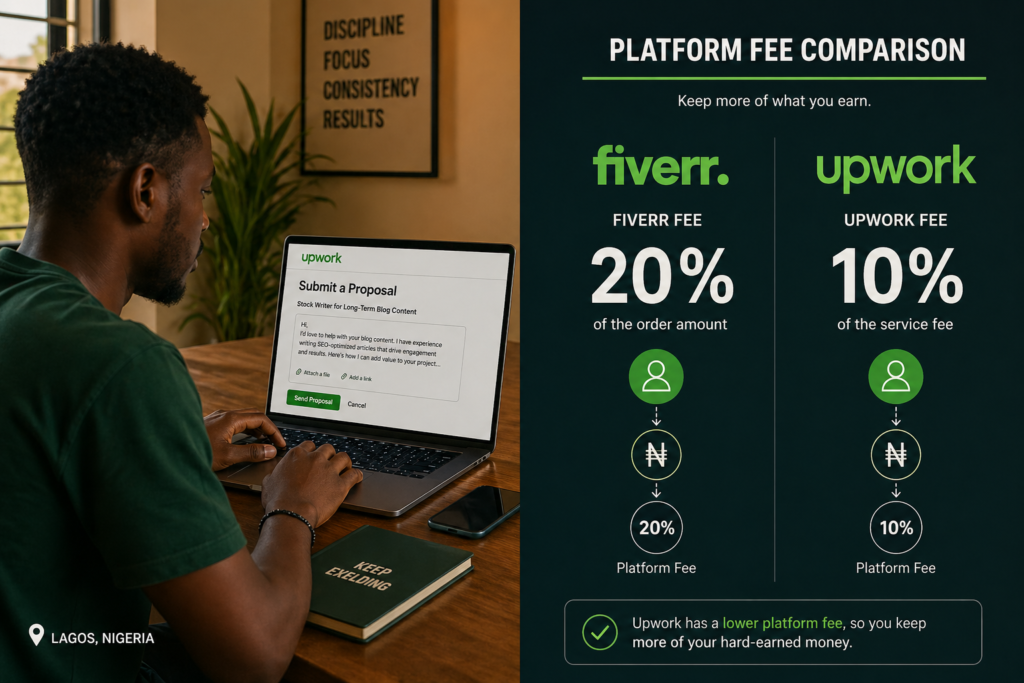
Platform fee reality: If you earn $50,000 on Fiverr over a year, you will pay approximately $10,000 in fees. On Upwork, the same earnings cost roughly $5,120 in fees. A practical strategy used by experienced African freelancers: use Fiverr for discovery and new client acquisition, then move long-term clients to Upwork or direct contracts.
For Data Annotation and AI Training Work
- Scale AI — scaleai.com
- Sama — sama.com (Kenya-focused hiring)
- Labelbox — labelbox.com
- Appen — appen.com
For Remote Full-Time Roles
- Upwork Talent Scout (invitation-based)
- Andela
- Remote.co
- Turing
- LinkedIn Remote Jobs filter
For a detailed breakdown of what these roles actually pay, including entry-level versus senior salary ranges for software developers, data scientists, and product managers across Nigeria, Kenya, and South Africa, see the full AI career paths and salary benchmarks across Nigeria, Kenya, and South Africa.
Section 4: How to Get Paid in Africa
Getting paid by international clients is one of the most practical challenges African freelancers face. Here is a simple, country-specific breakdown.
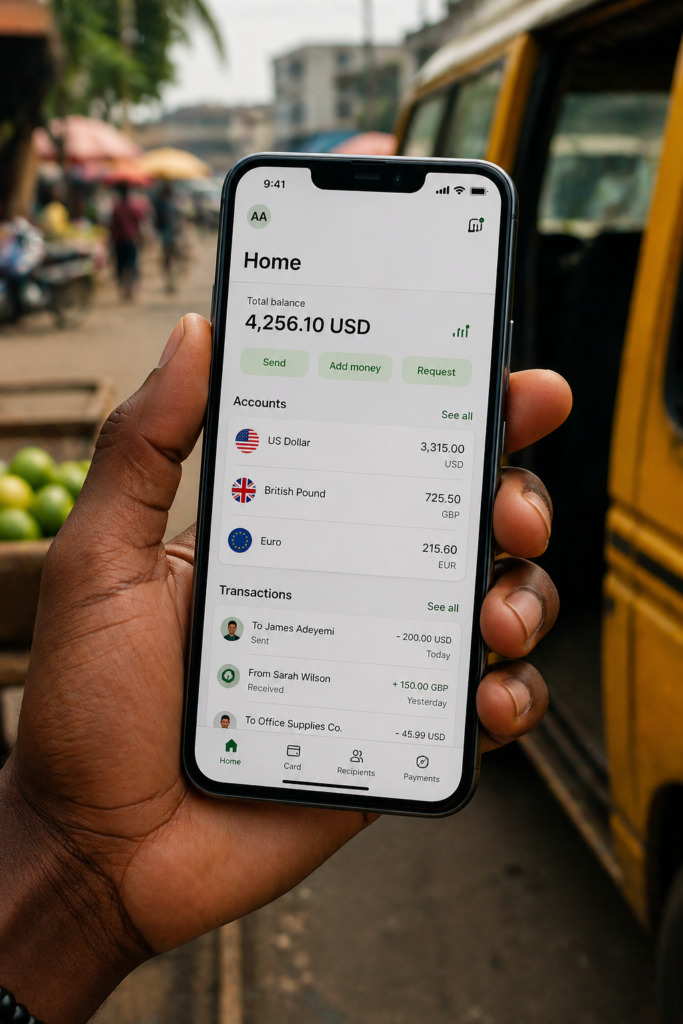
Recommended Payment Options by Country
| Country | Best option | Approximate fee | Why it works |
|---|---|---|---|
| Nigeria | Grey or Cleva | ~0.8% (capped at $10) | Fast naira access, clean USD wallet |
| Kenya | M-Pesa + Wise | 0.7–0.85% | Mobile money integration is seamless |
| South Africa | Wise | 0.7–0.85% | Best exchange rates for rand |
| Ghana | Grey or Flutterwave | 0.8–3% | Cedi support with reasonable fees |
Managing Data Costs
If data costs are a constraint, and in many parts of Nigeria and Ghana, they are, prioritize text-based AI tools over image or video generators. ChatGPT and Claude are both accessible on low-bandwidth connections. MTN Nigeria’s night plans (₦25 for 250MB as of early 2026) can cover several hours of text-based AI work.
Section 5: Your 30-Day Plan to Land a First Paid Gig
This is not a motivational framework. It is a specific sequence.
Week 1: Choose one skill and enroll in a free course. Do not evaluate all five skills above and try to do all of them. Pick one that matches your existing background most closely. Enroll in a free program — AltSchool Africa, She Code Africa, Zapier University, or YouTube — and start the first module today.
Week 2: Build your proof of work. Complete three to five small projects using your chosen skill. These do not need to be paid. They need to be good enough to show a potential client what you can do. Set up a payment account (Grey, Cleva, Wise, or M-Pesa) so you can receive money when a client says yes.
Week 3: Apply to 15 targeted gigs. Do not spray applications broadly. Find 15 specific job postings or clients that match your skills and write a short, specific pitch for each one. Use the job description language in your response. A Nigerian developer who rewrote his resume using exact keywords from three job descriptions went from zero callbacks on 47 applications to five callbacks on his next 12.
Week 4: Deliver, collect feedback, and improve. Prioritize quality over speed on your first project. Ask for a testimonial or review after delivery. Use the feedback to identify one specific thing to improve. Raise your rate by 20–30% on your next proposal.
Common Mistakes That Slow African Freelancers Down
- Learning too many tools at once. Pick one and go deep for 30 days before adding another.
- Underpricing without a plan. Low prices are fine at the start if they lead to testimonials and referrals. Low prices with no upgrade plan just build a low-income trap.
- Ignoring platform fees. Earning $10,000 on Fiverr means taking home roughly $8,000. Know your real numbers before you price your work.
- Skipping the portfolio step. A profile with no samples gets ignored. Three strong samples — even unpaid ones — make a significant difference in response rates.
- Waiting to feel ready. The first project always feels premature. Do it anyway.
Frequently Asked Questions
What is the best AI skill to learn in Nigeria in 2026?
The best AI skill depends on your existing background. Start with what you’re already good at. Strong writers can break in quickly through AI-assisted content work, where demand is high on global freelance platforms. If you think in systems and enjoy structured problem-solving, no-code AI automation offers higher pay with relatively low competition locally. And if you’re fluent in Hausa, Yoruba, or Igbo, multilingual data annotation is one of the fastest, most accessible ways to start earning from AI without technical training. Pick the skill closest to what you already know. That is the fastest path to your first paid gig.
How much can I realistically earn with AI tools in Africa?
It depends on the skill and how consistently you work. Beginners doing data annotation or content writing typically earn between $500 and $1,000 per month in their first six months. Intermediate freelancers with a portfolio and testimonials commonly reach $1,500 to $3,000 per month. No-code automation specialists and prompt engineers on long-term client retainers have reported earnings above $3,000 per month after 12 to 18 months. These are realistic ranges based on patterns across the freelance market, not guarantees. Your results depend on the skill you choose, how quickly you build proof of work, and how consistently you pitch.
How do I get paid as a freelancer in Nigeria, Kenya, or Ghana?
The most reliable options vary by country. Nigerian freelancers widely use Grey and Cleva for receiving USD payments with fast naira conversion and low fees — roughly 0.8% capped at $10. Kenyan freelancers typically combine M-Pesa with Wise for the most seamless mobile money experience. Ghanaian freelancers use Grey or Flutterwave for cedi-compatible withdrawals. In South Africa, Wise offers the best exchange rates for the rand. The key rule: set up your payment account before you land your first client. Scrambling to receive money after a client says yes creates delays and looks unprofessional.
Do I need a degree or coding experience to earn money with AI in Africa?
No. Three of the five income paths in this guide — prompt engineering, data annotation, and multilingual NLP work — require no coding and no formal degree. What they do require is attention to detail, strong written communication, and the discipline to learn one skill consistently for 30 days before expanding. Platforms like AltSchool Africa and She Code Africa offer free or subsidized training specifically designed for beginners. Your ability to follow instructions carefully and deliver quality work consistently matters far more than credentials on most freelance platforms.
Is it possible to do this work on a smartphone in Africa?
Yes, and many African freelancers already do. Text-based AI tools, ChatGPT, Claude, and Grammarly run cleanly on mobile browsers and use minimal data. Content writing, prompt engineering, and data annotation can all be done entirely from a phone. A Lagos-based YouTube creator with 180,000 subscribers scripts, edits, and publishes all his content using only a phone and CapCut. For no-code automation work, a laptop is more practical but not always essential for simpler workflows. If data costs are a concern, prioritize text-first tools and use night data plans. MTN Nigeria’s ₦25 for 250MB plan covers several hours of text-based AI work.
Closing: The Gap Is Smaller Than It Looks
Africa’s AI opportunity is not theoretical. It is paying people right now — content writers, automation builders, data annotators, and prompt specialists across Lagos, Nairobi, Accra, and Johannesburg.
The gap between AI-curious and AI-paid is almost always an execution gap, not a knowledge gap or a resource gap.
Pick one skill from this guide. Learn it for 30 days. Land one paid project. Then raise your rate.
That sequence, repeated consistently, is what separates the freelancers earning $500 per month from those earning $3,000.
Questions or success stories? Email the team at boldbeautifulcreators@gmail.com